Hammer mills are made and sold locally in kwacha, driven by electric motors, diesel engines or, increasingly, solar power with batteries, and a mill costs a small part of what a mealie meal plant costs. A hammer mill makes roller meal well; it cannot make breakfast meal, the finer, whiter grade sold in supermarkets, which needs degerming, roller milling and sifting. Productive machinery for agriculture enters at 0% duty and most capital equipment in the 0–5% band, with 16% import VAT. Power has improved: in June 2026 ZESCO said it did not expect nationwide load management to return this year, after the Kariba water allocation for 2026 was raised to 36 billion cubic metres. CISH supplies, installs and commissions complete mealie meal plants in Zambia.
Hammer mill prices in Zambia, 2026
| What you buy | Use | Indicative price (2026) | Fits |
|---|---|---|---|
| Electric hammer mill | Service milling, roller meal | Sold locally in kwacha; a small part of a plant budget | Mills with a grid connection |
| Diesel hammer mill | Service milling where power is weak | Sold locally in kwacha | Rural centres, backup |
| Solar-powered hammer mill | Daytime milling off-grid | Sold locally; price depends on panels and batteries | Off-grid villages and farms |
| Dehuller and hammer mill set | Whiter roller meal | Priced per set | Mills improving their meal |
| Complete mealie meal plant | Breakfast and roller meal, about 30 t/day | About US$250,000–400,000 landed and commissioned | Branded meal for shops and supermarkets |
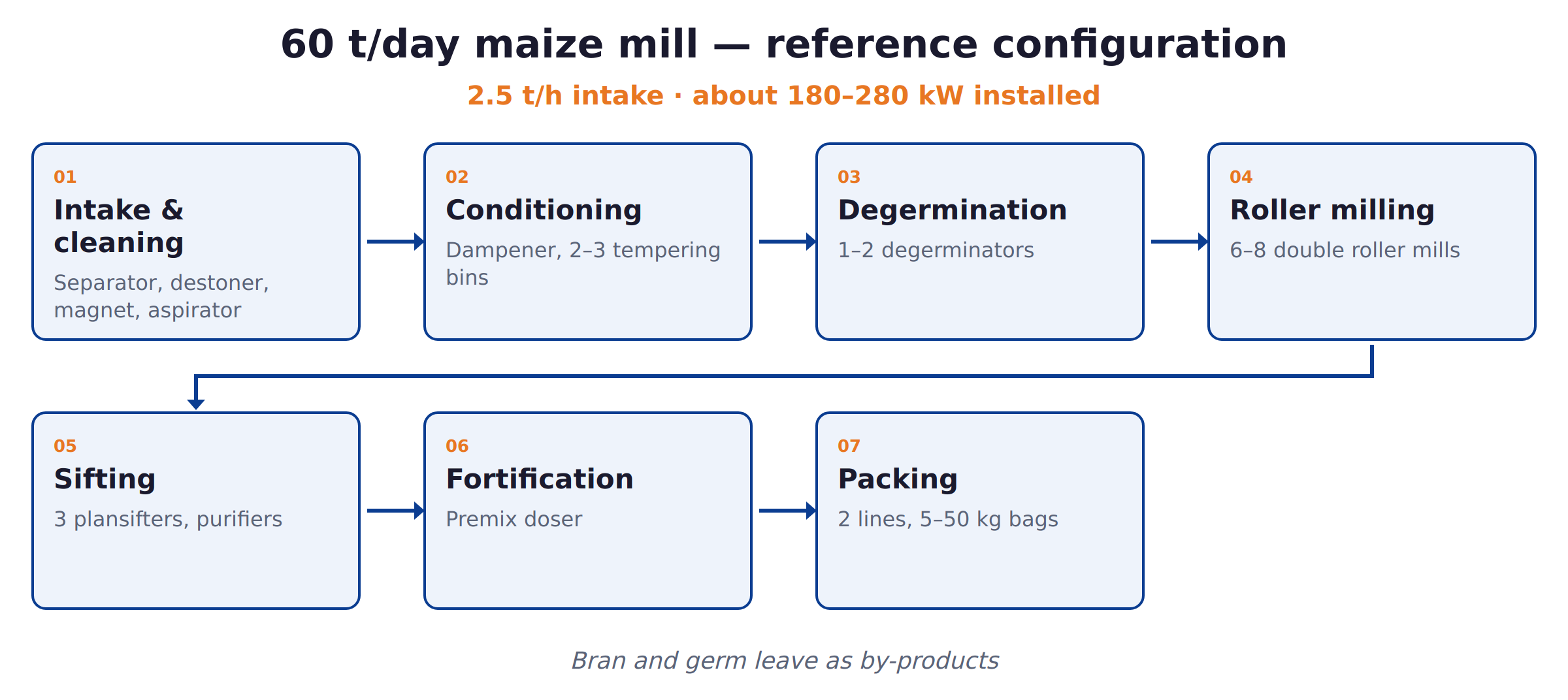
| Larger plant | About 60 t/day | About US$700,000–1.1 million | Regional millers |
Roller meal or breakfast meal?
| Roller meal | Breakfast meal | |
|---|---|---|
| What it is | Coarser, higher-extraction meal | Finer, whiter, lower-extraction meal |
| Machine | Hammer mill, sometimes with a dehuller | Degerming, roller mills, sifters |
| Price per bag | Lower | Higher |
| Buyers | Households, compounds, rural markets | Supermarkets, urban shops |
| Investment | Low | High |
Our guide to starting a mealie meal business in Zambia explains how the mix of the two decides the plant.
Electric, diesel or solar?
- Electric: cheapest per bag where the grid is reliable. ZESCO said in June 2026 that supply was stable after investment in hydro, thermal and solar generation and partnerships with independent producers.
- Diesel: works anywhere and during outages; fuel is the main running cost.
- Solar with batteries: no fuel bill and growing in off-grid areas; size panels and batteries for the motor and the hours you mill.
- Hybrid: many mills keep a diesel engine as backup.
The memory of long load-shedding during the 2024 drought, when Kariba's usable storage fell very low, is why many millers keep backup even now.
Importing equipment into Zambia
| Item | 2026 basis |
|---|---|
| Duty | 0–5% band for capital equipment; productive machinery for agriculture at 0% |
| VAT | 16% on customs value plus duty |
| Valuation | CIF basis |
| Standards | ZABS for regulated goods |
| Route | Dar es Salaam, Durban, Walvis Bay or Beira, then by road |
| Landed factor | About 1.45–1.60 times ex-works for equipment priced at the factory; our plant prices already include it |
Our Zambia import guide compares the corridors.
Worked example: a compound mill in Lusaka
A miller in a Lusaka compound runs one electric hammer mill for service milling and sells roller meal in 10 kg and 25 kg bags. During the 2024 load-shedding the mill stood idle for hours every day, so he added a diesel engine. Now he adds a solar system for daytime milling and keeps the diesel as backup. A supermarket asks for breakfast meal; he does not try to make it on the hammer mill, and plans a small degerming and roller plant when he has the buyers and the maize storage. The figures are illustrative.
How to choose a hammer mill
- Motor or engine size for your output.
- Screens for the fineness your customers want.
- Hammer material and how easily they can be turned or replaced.
- Rotor balance and bearing quality.
- Dust control and a clean discharge.
- Local service and spare hammers and screens.
What we see in Zambia
- Hammer mills make most roller meal.
- Breakfast meal needs a roller plant.
- Solar mills are growing off-grid.
- Power improved in 2026, but many mills keep backup.
- Agricultural machinery enters at 0% duty; most capital equipment at 0–5%.
- Imported plants carry corridor costs that a local mill does not.
Hammers, screens and the meal customers want
Customers judge a hammer mill by the meal: fine enough for nshima, even, free of grit, and milled quickly. Screen size decides fineness; worn hammers and torn screens make coarse, uneven meal and use more power per bag. Keep spare hammers and screens, turn hammers when one edge wears, and check the rotor balance and bearings regularly. A well-kept mill wins customers from a neglected one at the same fee.
Running a mill as a business
Track bags milled, fees collected and units of power or litres of fuel used every day. Prices for milling are well known in each area, so profit comes from volume and cost per bag. A second mill, a dehuller for whiter meal, or selling your own roller meal in bags during the lean season can add income without a large investment.
When customers ask for breakfast meal
If shops ask for breakfast meal, do not try to make it on a hammer mill. Breakfast meal needs degerming and roller milling; work out the volumes you can sell, the maize storage you will need and the power supply before you plan a plant.
Safety at the mill
Hammer mills run fast and throw dust. Guard belts and pulleys, keep hands away from the hopper throat, fit dust covers, and keep the mill house clean, because maize dust can catch fire. Store diesel away from the engine, and keep a fire extinguisher near the door.
Licensing and hygiene
Register the business and obtain the local council's licence for the premises. If you bag and sell meal, keep the mill house clean, dry and free of pests, and label bags with the product, weight and your details. Supermarkets will expect products that meet Zambian standards.
From a delivered project: On a delivered 60 t/day super-fine maize mill more than six hours from the nearest engineering hub, the mill itself was the easy part: extra pre-cleaning for maize at 11–16% moisture, an on-site critical-spares buffer and a year of support took the plant to about 85% of nameplate by month four. Read the maize mill case study.
Where CISH fits
For a hammer mill, a Zambian workshop or dealer is usually the better buy, and we will say so. When a business moves to breakfast meal and branded packs, CISH supplies complete mealie meal plants, cleaning, degerming, roller milling, sifting and packing, from audited factories in China, ships them through the best corridor for the season, clears, installs and commissions them, and trains your miller.