Groundnut kernels are rich in oil, so a screw press recovers a large share of it; soya is much leaner and is usually solvent-extracted at scale. CISH supplies, installs and commissions complete oil pressing and refining lines; for a single press, a local fabricator or dealer is the better buy.
Groundnut oil machine prices in 2026
| What you buy | Typical capacity | Indicative price (2026) | Fits |
|---|---|---|---|
| Single screw press with filter | A few hundred kg of kernel an hour | Under US$10,000 | Crude oil for local traders |
| Pressing unit with roaster, press and filter press | Small batches to a few tonnes a day | Quoted per configuration | Crude oil and cake at village or town scale |
| Complete pressing and refining line | About 20 t of seed a day | About US$150,000–400,000 | Refined oil in bottles or jerrycans |
| Larger line with refining | About 50 t of seed a day | About US$400,000–900,000 | Regional brands |
| Industrial line | About 100 t a day | US$700,000–1.5 million and up | Large processors with steady grain supply |
These are equipment and line prices in US dollars. In Nigeria, a landed and installed project usually costs about 1.25–1.45 times the ex-works line price once freight, duties, clearance, installation and the building work are counted. We do not quote naira prices, because the exchange rate moves too often for a printed figure to stay right.
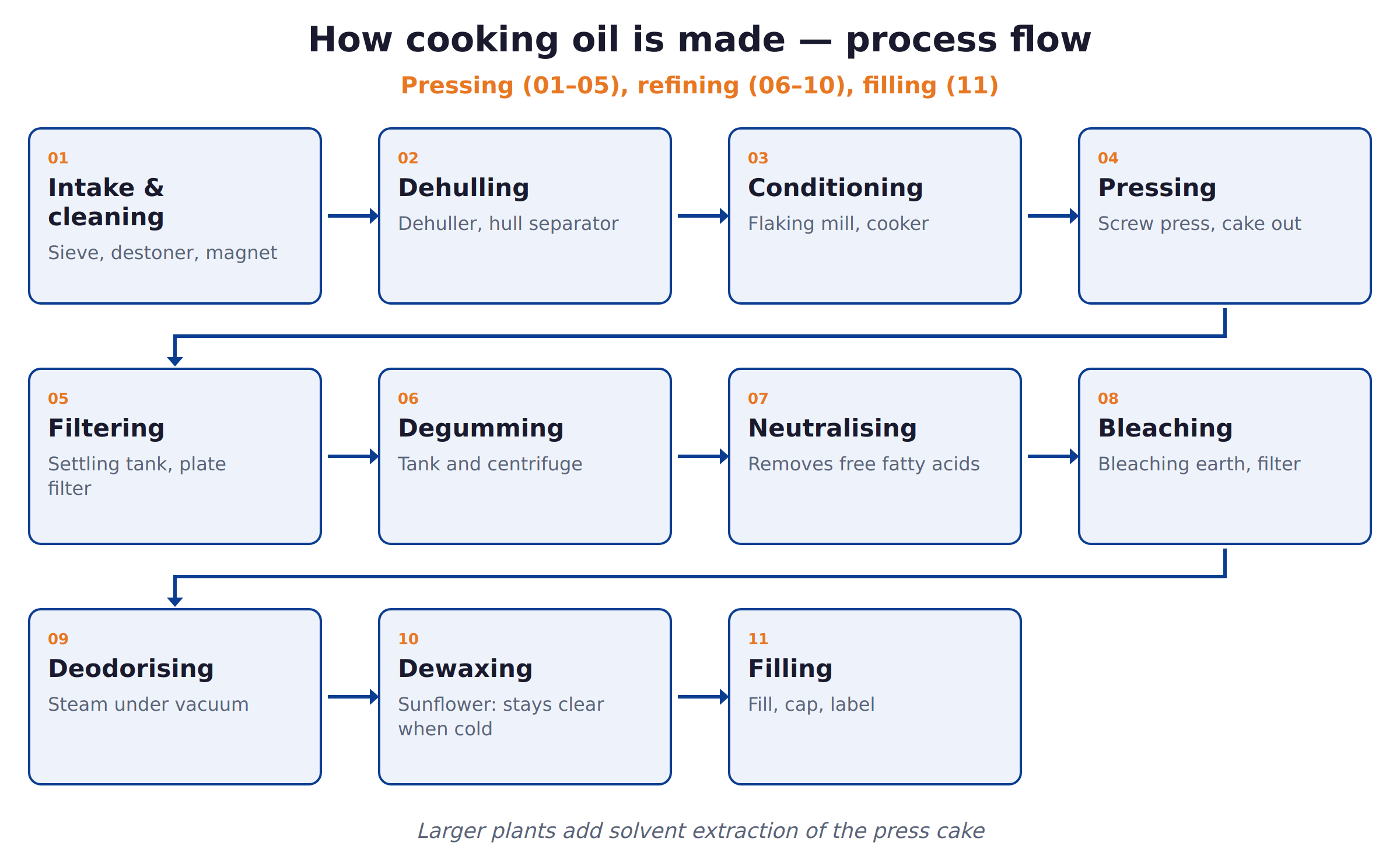
Crude oil or refined oil: the decision that sets the line
| Crude groundnut oil | Refined groundnut oil | |
|---|---|---|
| Equipment | Cleaner, decorticator, roaster, screw press, filter | Everything for crude oil, plus degumming, neutralising, bleaching, deodorising and filling |
| Buyers | Market traders, food sellers, households who like the strong taste | Shops, supermarkets, food factories |
| Shelf life | Shorter; cloudy oil can go rancid faster | Longer, clear and stable |
| Registration | Check what your buyers and NAFDAC require | NAFDAC registration for the packed product |
| Capital | Low | Several times higher |
Many Nigerian processors start with crude oil for traders and add refining later. That works if the first line is laid out so a refinery can be added without moving the press section.
Oil yield: groundnut versus soya
Groundnut kernels typically contain about 45–50% oil. A well-run screw press leaves only a few per cent of oil in the cake, so most of the oil comes out mechanically. Soya beans contain far less oil, around a fifth of their weight, and a screw press leaves much of it behind, which is why large soya plants use solvent extraction.
| Seed | Oil in the seed (typical) | Best extraction route at small and medium scale |
|---|---|---|
| Groundnut kernels | About 45–50% | Roasting or conditioning, then screw pressing, often in two passes |
| Soya beans | About 18–20% | Expeller pressing for full-fat cake, or solvent extraction at large scale |
| Sunflower seed | About 38–42% | Screw pressing, then refining |
Ask every seller for the oil yield on your seed, measured as kilograms of filtered oil per 100 kg of kernel, and the residual oil left in the cake. A press that leaves twice as much oil in the cake costs you money every day.
Kuli-kuli and groundnut cake
The cake left after pressing is not waste. In northern Nigeria it is fried and sold as kuli-kuli, a snack that sells in markets across the country. Cake is also sold to feed mills as protein for poultry and fish feed. When you plan the mill, price both products:
- Kuli-kuli: needs grinding, kneading, shaping and frying; a small add-on, but it adds labour.
- Cake for feed: sold by the bag to feed millers; aflatoxin control matters, because feed buyers test for it.
A line that sells oil and cake together usually pays back faster than one that sells oil alone.
Who sells groundnut oil machines in Nigeria
| Seller | What they sell | Strength | Watch out for |
|---|---|---|---|
| Local fabricators | Roasters, kneaders, frames and small presses built to order | Low price, fast repairs | Press screws and cages wear fast if steel is soft |
| Dealers of imported machines | Screw presses and filters from stock | Quick delivery | Usually machine by machine, without a line design |
| Chinese factories, direct | Presses, filter presses, refineries and complete lines | Lowest price on paper | You carry installation and output risk |
| Turnkey companies | Complete cleaning, pressing, refining and filling lines | One party answers for output | Higher quote than a bare machine |
This page names no suppliers and ranks none. Whoever you choose, ask to see a press running on groundnut, not on sunflower or soya, because each seed behaves differently in the press.
What a complete groundnut oil line includes
- Cleaning and destoning: sand and stones wear the press quickly.
- Decorticating (shelling): if you buy unshelled nuts.
- Roasting or conditioning: the right moisture and temperature raise yield.
- Screw pressing: one or two passes.
- Filtering: plate filter press for clear crude oil.
- Refining (optional): degumming, neutralising, bleaching, deodorising.
- Filling and capping: bottles, jerrycans or drums.
- Cake handling: cooling, grinding, bagging.
- Utilities: a boiler or thermal oil heater for refining, compressed air, water.
- Power: grid connection, generator or hybrid supply.
Power: plan for self-generation
Grid supply in Nigeria is still short of demand. NERC's quarterly reports show available generation of roughly 5 GW for a country of more than 200 million people, and manufacturers reported spending about ₦1.4 trillion on their own power in 2025, according to MAN data reported by BusinessDay. For an oil mill, that means:
- Size the generator for the press motors' starting load, not only their running load.
- Refining needs steady heat, so plan the boiler fuel as carefully as the electricity.
- Solar can carry lighting and small loads, but press motors usually need a generator or grid.
Ask each seller for the installed kW of every motor and heater, so your generator can be sized correctly.
Importing the line into Nigeria
| Item | How it works |
|---|---|
| Import duty | Under the ECOWAS Common External Tariff, capital equipment generally sits in the 5% band; confirm the HS code for each machine |
| Surcharge and levies | A 7% surcharge on the duty amount, a 1% Comprehensive Import Supervision Scheme charge on FOB value, and the 0.5% ECOWAS Trade Liberalisation Scheme levy on CIF value |
| VAT | 7.5% |
| 4% FOB charge | Announced in 2025, then suspended by Customs; confirm the current position before you ship |
| Form M | Opened through your bank on the B'Odogwu trade portal before shipment |
| Ports | Usually Lagos (Apapa, Tin Can or Lekki), then road transport north to the groundnut belt |
See our import guide for Nigeria for the sequence.
Worked example: a 20 tonne a day groundnut oil mill
An illustration only, not a quote:
| Item | Assumption |
|---|---|
| Kernels pressed | 20 t a day |
| Filtered crude oil | Roughly 40% of kernel weight, about 8 t a day, depending on seed and press |
| Cake | About 11–12 t a day for kuli-kuli or feed |
| Line price ex-works | Within US$150,000–400,000, depending on refining and filling |
| Landed and installed | About 1.25–1.45 times the ex-works price |
| Grain stock | Several months of kernels after harvest, the biggest working-capital item |
The machine is rarely the hardest part. Buying and storing enough groundnut after harvest, and financing it, usually decides whether the mill runs all year.
How to compare quotes
- Kernel throughput per day, stated for groundnut.
- Oil yield and residual oil in cake, with how they will be measured at handover.
- Press screw and cage material, and their expected life.
- Roaster or conditioner included, with fuel type.
- Filter press size and cloth supply.
- Refining section included or not, with chemical and fuel use.
- Filling machine type and container sizes.
- Installed power and the generator size you will need.
- Installation, commissioning on your groundnut, and operator training.
- Warranty terms and who answers for output.
Put each quote on the same scope before comparing. Our page on whether buying through CISH costs more shows how.
Mistakes we see
- Buying a press before deciding crude or refined. The building, utilities and layout differ.
- Testing the press on the wrong seed. A press that runs well on sunflower may not run well on groundnut.
- No cleaning section. Sand in the kernels destroys screws and cages.
- Ignoring aflatoxin. Feed buyers and food regulators test for it; buy and store kernels carefully.
- Undersized generator. Press motors stall or burn out on weak supply.
- No plan for grain stock. The mill stands idle months after harvest.
Nigerian facts that shape the decision
- A large crop. Nigeria was projected to harvest about 4.3 million tonnes of groundnut in the 2025 season, according to figures reported by BusinessDay, which keeps it among Africa's largest growers.
- Local by-products. Groundnut is eaten roasted, boiled and fried, and processed into kuli-kuli, peanut butter and sweets, so cake and kernels have more than one market.
- Packed food registration. Packed oil sold to shops needs NAFDAC registration; plan the label, batch coding and test results early.
- Finance is costly. CBN figures put maximum lending rates above 30% in 2026, so the size of your grain stock matters as much as the machine price.
- Duty is moderate on machinery. Most capital equipment sits in the low ECOWAS CET band, with the surcharge, CISS and ETLS levies and 7.5% VAT on top.
- Form M first. Without a valid Form M on the B'Odogwu portal, the shipment cannot clear.
- Self-generated power. Manufacturers spend heavily on their own power, so diesel or gas per tonne of oil belongs in your costing.
- Price in dollars. Imported lines are priced in US dollars, and the naira rate changes the local cost between quote and payment.
Where CISH fits
CISH supplies, installs and commissions complete groundnut oil lines from audited factories in China: cleaning, shelling, roasting, pressing, filtering, refining, filling and cake handling, shipped to Nigeria and commissioned on your groundnut with operators trained. We suit processors who want crude and refined oil from one planned line. For a single screw press, a local fabricator or dealer is the better choice, and we will say so.