Floating feed is made by extrusion: ground, mixed and steam-conditioned ingredients are cooked under pressure in an extruder and expand as they leave the die. Poultry and pig feed, by contrast, is pressed into sinking pellets on a pellet mill. Imports pay ECOWAS CET duty plus surcharge, CISS, ETLS and 7.5% VAT, and power must be self-generated in most places.
Feed machine prices in Nigeria, 2026
| What you buy | Capacity | Indicative price (2026) | Makes |
|---|---|---|---|
| Single extruder | About 40–1,200 kg/h | About US$2,000–60,000 ex-works | Floating or sinking fish feed, if fed with conditioned mash |
| Complete floating fish feed line | 1–2 t/h | About US$75,000–500,000 ex-works | Catfish and tilapia feed, consistent float and size |
| Small pellet feed mill | 1–3 t/h | About US$60,000–150,000 landed and commissioned | Poultry, pig and cattle pellets |
| Industrial feed plant | Several tonnes an hour, several lines | Quoted per configuration | Fish, poultry and livestock feed at scale |
Complete lines are priced in US dollars. Ingredients and labour are paid locally in naira.
Floating feed: why the dryer matters as much as the extruder
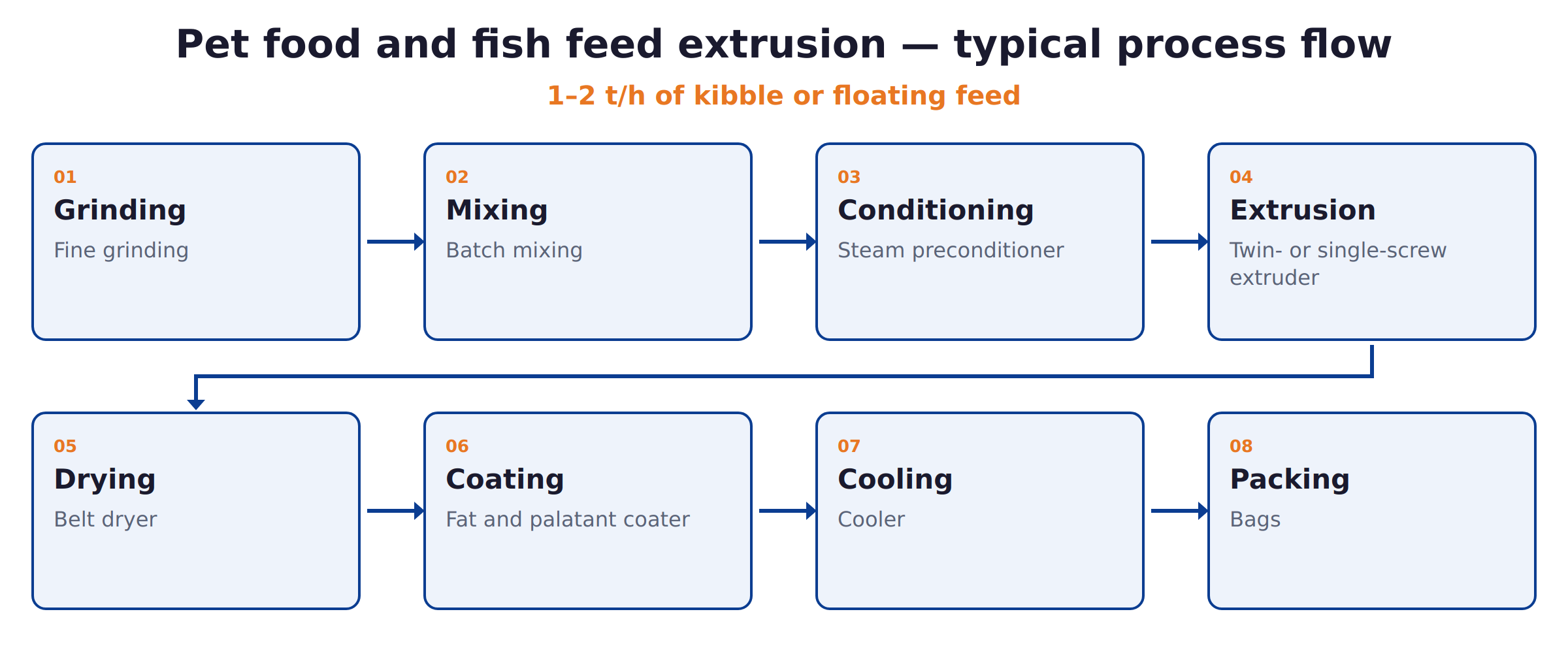
A small extruder alone can make floating pellets, but they come out hot and wet. Without a dryer and cooler they go mouldy in the bag, and without a coater they lack the oil that catfish feed needs. A complete line includes:
- Grinding ingredients fine, usually through a hammer mill with a fine screen.
- Batching and mixing maize, soybean meal, fish meal, wheat offal, vitamins and minerals.
- Conditioning with steam to start cooking the starch.
- Extruding and cutting to size, from fine fry feed to larger grower feed.
- Drying to a safe moisture level.
- Oil coating and cooling.
- Sifting and bagging.
Fish feed or poultry feed?
| Floating fish feed | Poultry and livestock feed | |
|---|---|---|
| Machine | Extruder with conditioner, dryer and coater | Pellet mill, or mash only |
| Pellet | Expanded, floats | Dense, sinks |
| Energy use | Higher: steam, extrusion, drying | Lower |
| Price per tonne of feed | Higher | Lower |
| Main buyers | Catfish and tilapia farmers | Poultry farms, piggeries |
Some mills run both: a pellet line for poultry and an extrusion line for fish, sharing grinding and mixing.
Ingredients drive cost
Feed ingredients, maize, soybean meal, fish meal, oils and premixes, are most of the cost of a tonne of feed, and many are priced with the exchange rate. A feed business needs storage for several weeks of ingredients, a laboratory or testing arrangement for protein and moisture, and a formulation that balances cost against fish growth. Feed mills that buy maize at harvest and store it well make better margins.
Power and steam
Extruders, hammer mills, dryers and boilers all need power or fuel. NERC's third-quarter 2025 report put national grid availability at about 5.4 GW, and manufacturers spent around ₦1.4 trillion on self-generation in 2025, according to the Manufacturers Association. Plan a generator, a boiler fuel (diesel, gas or biomass) and the running cost per tonne before choosing the line size.
Landed cost in Nigeria
| Item | Basis |
|---|---|
| Duty | ECOWAS CET band for each HS code |
| Surcharge | 7% of the duty |
| CISS | 1% of FOB |
| ETLS | 0.5% of CIF |
| VAT | 7.5% on value plus duties |
| Form M | Through the B'Odogwu portal |
| 4% FOB charge | Suspended; check before shipping |
Worked example: a catfish farm making its own feed
A catfish farm in Ogun State buys imported floating feed and wants to cut its feed bill. It installs a floating feed line of about 1 tonne an hour: hammer mill, mixer, conditioner, extruder, dryer, coater, cooler and bagging, with a small boiler and a generator. It uses part of the output on its own ponds and sells the rest to neighbouring farms. The first months are about formulation: float rate, pellet size and protein level are adjusted with feeding trials. Credit at a maximum lending rate around 33% in mid-2026 makes it sensible to start with one line and grow. The figures are illustrative.
How to compare quotes
- Tonnes per hour of dried, coated feed, not extruder throughput alone.
- Single- or twin-screw extruder, and dies for each pellet size.
- Conditioner steam requirement.
- Dryer capacity at your moisture target.
- Coater for oil.
- Grinding fineness for fish feed.
- Power and steam needs; boiler and generator size.
- Installation, commissioning on your formula, and training.
- Spares: screws, barrels, dies, knives.
- References of fish feed plants in West Africa.
Choose by situation
- Small fish farm testing own feed: a small extruder with a simple dryer.
- Feed supplier to catfish farms: a complete 1–2 t/h floating feed line.
- Poultry feed business: a pellet feed mill.
- Integrated feed company: pellet and extrusion lines sharing grinding and mixing.
Pellet sizes and feeding stages
Catfish farmers buy feed in several sizes as fish grow: fine crumbles or very small pellets for fry and fingerlings, then pellets of a few millimetres for juveniles, and larger pellets for growers. A feed line needs a set of dies for each size and a cutter that can be adjusted, and the protein level usually falls as pellet size rises. If you plan to sell across all stages, list every size in your quote request; changing dies takes time, so plan production runs by size rather than switching several times a day. Bag and label each size clearly so farmers buy the right feed.
Mistakes we see
- Extruder without a dryer. Feed spoils.
- Coarse grinding. Pellets sink or break.
- No oil coating on catfish feed.
- Ignoring steam and power costs.
- No ingredient storage.
What we see in Nigeria
- Catfish is the main market for floating fish feed.
- Floating feed needs a complete extrusion line, not an extruder alone.
- Ingredient prices move with the exchange rate.
- Grid capacity was about 5.4 GW nationally in 2025.
- Self-generation cost manufacturers about ₦1.4 trillion in 2025.
- Credit is expensive at a maximum lending rate around 33%.
- Imports pay CET duty plus surcharge, CISS, ETLS and VAT.
- Form M runs on B'Odogwu.
Where CISH fits
We supply complete floating fish feed and animal feed lines, grinding, mixing, conditioning, extrusion or pelleting, drying, coating and bagging, from audited factories in China, sized to your feeds. CISH ships and clears the line, installs and commissions it on your formula, and trains your team. For a single small extruder, a local dealer is usually the better choice.