Many Zimbabwean plants have idle capacity, so restoring an existing press or refinery can be cheaper than buying new. Imported equipment travels from Durban through Beitbridge, so landed costs run at about 1.45–1.60 times ex-works. Regulated goods need a CBCA certificate before loading, or pay a penalty of 12% of CIF value, and import VAT rose to 15.5% from January 2026. Power has been steady through 2026, but the July 2026 grid collapse showed why refineries need backup. CISH supplies, installs and commissions complete oil pressing and refining plants in Zimbabwe, and recovers idle ones.
Cooking oil machine prices in Zimbabwe, 2026
| What you buy | Capacity | Indicative price (2026) | Product |
|---|---|---|---|
| Single screw expeller with filter | Small | Under about US$10,000 | Crude or filtered oil |
| Pressing line | About 20 t of seed a day | About US$150,000–400,000 ex-works | Crude oil and cake |
| Pressing and refining plant | About 50 t a day | About US$400,000–900,000 ex-works | Refined bottled oil |
| Larger plant | About 100 t a day | About US$700,000–1.5 million+ | Refined oil at scale |
Soybean, sunflower or cottonseed?
| Soybean | Sunflower | Cottonseed | |
|---|---|---|---|
| Oil yield when pressed | Lower | Higher, roughly a third of seed weight | Moderate |
| Main value | Cake for stockfeed | Oil | Oil and cake |
| Pre-treatment | Cracking or extrusion | Cleaning, sometimes dehulling | Delinting and dehulling |
| Refining needs | Degumming | Winterising for clear oil | Neutralising; refining is essential before food use |
Cottonseed oil must be refined before it is used as food, because crude cottonseed contains gossypol. Plan refining if you process cottonseed.
Recover before you buy
Zimbabwe has many oil presses and refineries standing idle or running below capacity. Before buying new, check whether an existing plant can be restored: new screws and cages, filters, pumps, controls and a commissioning team can bring a plant back to output for far less than a new line. Our guide new, used or recover explains how to decide.
Oilcake and stockfeed
Soybean and cottonseed cake are protein ingredients for stockfeed, and sunflower cake is used too. Agree cake sales with feed makers before you start, keep cake dry and test its protein.
Power and backup
Presses, extruders and refinery pumps are heavy loads, and refining needs steady steam and vacuum. Zimbabwe went through the 2026 winter without scheduled load-shedding, but a fault caused a nationwide grid collapse on 6 July 2026, restored the same evening. Keep a generator for the refinery and critical sections.
Importing an oil plant into Zimbabwe
| Item | 2026 basis |
|---|---|
| Payments at import | Duty, surtax where applicable, and VAT, per the Tariff Handbook |
| VAT | 15.5% from 1 January 2026 |
| CBCA | Pre-shipment certificate for regulated goods; 12% of CIF penalty without it |
| Route | Durban, then Beitbridge |
| Landed factor | About 1.45–1.60 times ex-works |
Worked example: restoring a press line in Mutare
An oil processor in Mutare has a 30 t/day press line that has run at a third of capacity for years because of worn presses and a failed filter. A recovery project replaces press worms and cages, a filter press, two pumps and the control panel, and recommissions the line on sunflower and soya. Output returns to near rated capacity for a fraction of the cost of a new line, and the processor plans a small refinery next. The figures are illustrative.
How to compare quotes
- Tonnes of seed per day for each seed.
- Pre-treatment for soya and cottonseed.
- Residual oil in cake.
- Refining sections and losses.
- Steam, power and water.
- Installation, commissioning and training.
- Spares: worms, cages, cloths.
- References in southern Africa.
Choose by situation
- Small processor: an expeller and filter.
- Idle plant owner: recovery of the existing line.
- Seed trader adding value: a 20 t/day pressing line.
- Bottled oil brand: a 50 t/day plant with refining.
Our guides
The sunflower oil refining sizing guide sets out what each plant size needs.
What we see in Zimbabwe
- Soya, sunflower and cottonseed are the main oilseeds.
- Many plants are idle or under-used; recovery is often the first project.
- Cake sells to stockfeed makers.
- Power was steady in 2026, with occasional faults.
- CBCA certificates come before shipment.
- VAT is 15.5% from January 2026.
Refining cottonseed safely
Crude cottonseed oil contains gossypol, a natural compound that must be removed before the oil is used as food. Neutralising with caustic soda, bleaching and deodorising remove it, along with free fatty acids and colour, so a cottonseed plant needs a proper refinery and laboratory checks. Processors without refining should sell crude cottonseed oil only to refiners or for non-food uses, and press soybeans or sunflower for local food oil sales.
Seed buying and storage
Oilseeds are harvested once a year, so plants that run all year must buy and store seed. Store seed dry, on pallets, away from walls, with pest control and regular moisture checks. Seed bought on credit has a cost, so plan finance and sales together.
Bottling and selling
Refined oil sells in bottles to supermarkets, wholesalers and shops; crude or filtered oil sells in bulk to traders and food businesses. Clean filling, sealed caps, clear labels and batch numbers help bottled oil win shelf space.
Space and utilities
A pressing plant needs seed storage, a pressing hall, oil tanks and a cake store; a refinery adds a boiler, cooling water, a vacuum system and a laboratory. Plan three-phase power, water and drainage before equipment arrives, and allow for generator backup for the refinery.
Quality checks
Test oil for free fatty acids, peroxide value and moisture on every batch, keep retained samples, and record the seed lot and processing conditions. Supermarkets and food manufacturers expect consistent oil, and records help you solve problems quickly when a batch is off. Cake should be tested for protein and moisture so you can price it fairly to stockfeed makers.
Staff and training
Train press operators to set presses for each seed, clean filters on schedule and record oil and cake output every shift; a trained refiner is essential for cottonseed. Good records show quickly when a press needs new worms or a filter needs new cloths.
Where CISH fits
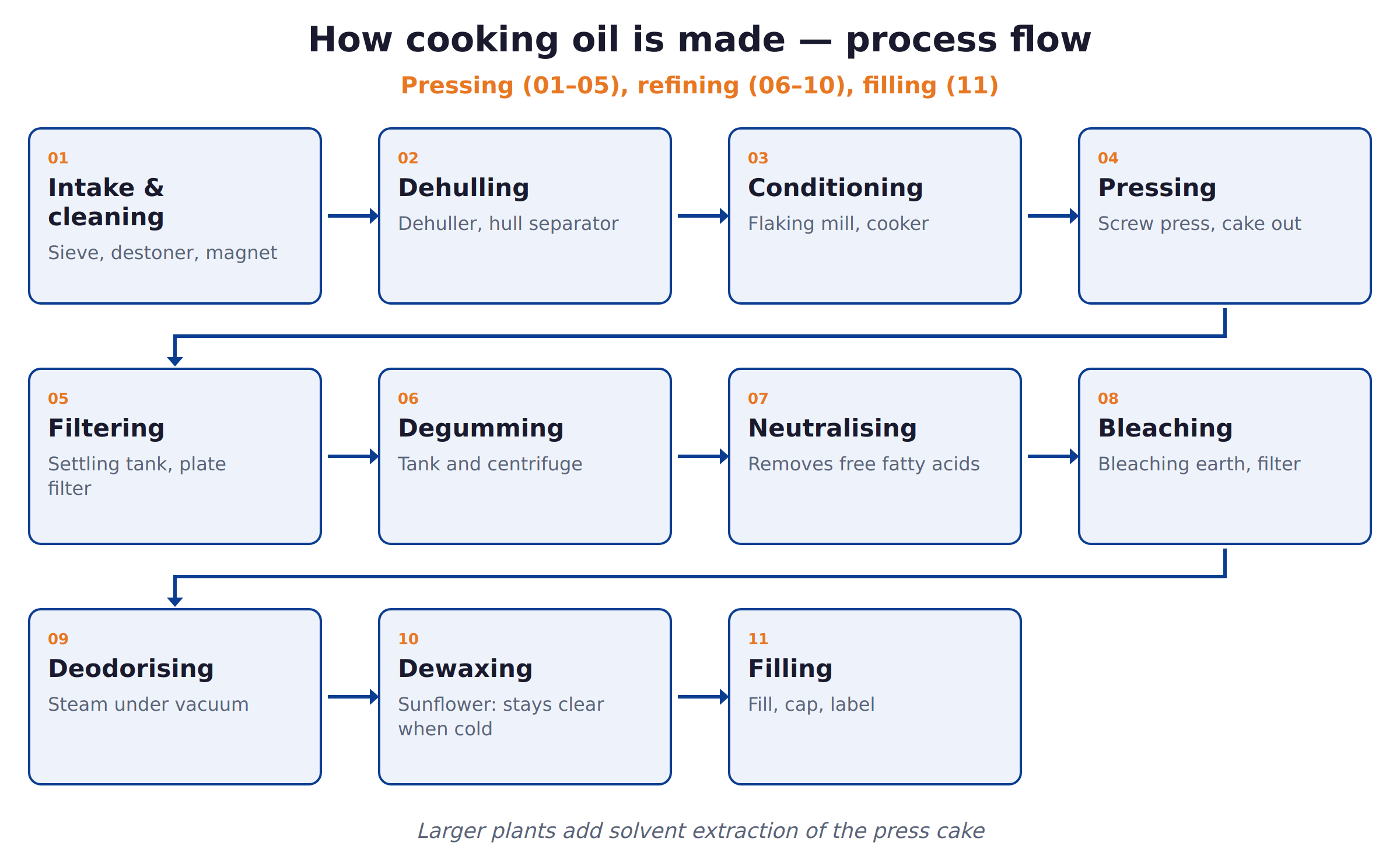
We supply complete oil plants, seed preparation, pressing, filtering, refining and filling, and we recover idle plants. CISH sources from audited factories in China, arranges the CBCA inspection with our factory test, ships through Durban and Beitbridge, clears, installs and commissions the plant on your seed, and trains your team. For a single expeller, a local supplier is usually the better buy.