Single expellers with a filter cost under about US$10,000. Because Zambia is landlocked, landed and installed costs run at about 1.45–1.60 times ex-works through Dar es Salaam, Durban, Walvis Bay or Beira. Productive machinery for agriculture enters at 0% duty and most capital equipment in the 0–5% band, with 16% import VAT. Presses and refineries are heavy power users; ZESCO said in June 2026 it did not expect nationwide load management to return this year, but plants that lived through the 2024 drought, when Kariba's usable storage fell to about 13%, still plan backup. CISH supplies, installs and commissions complete oil pressing and refining plants in Zambia.
Cooking oil machine prices in Zambia, 2026
| What you buy | Capacity | Indicative price (2026) | Product |
|---|---|---|---|
| Single screw expeller with filter | Small | Under about US$10,000 | Crude or filtered oil |
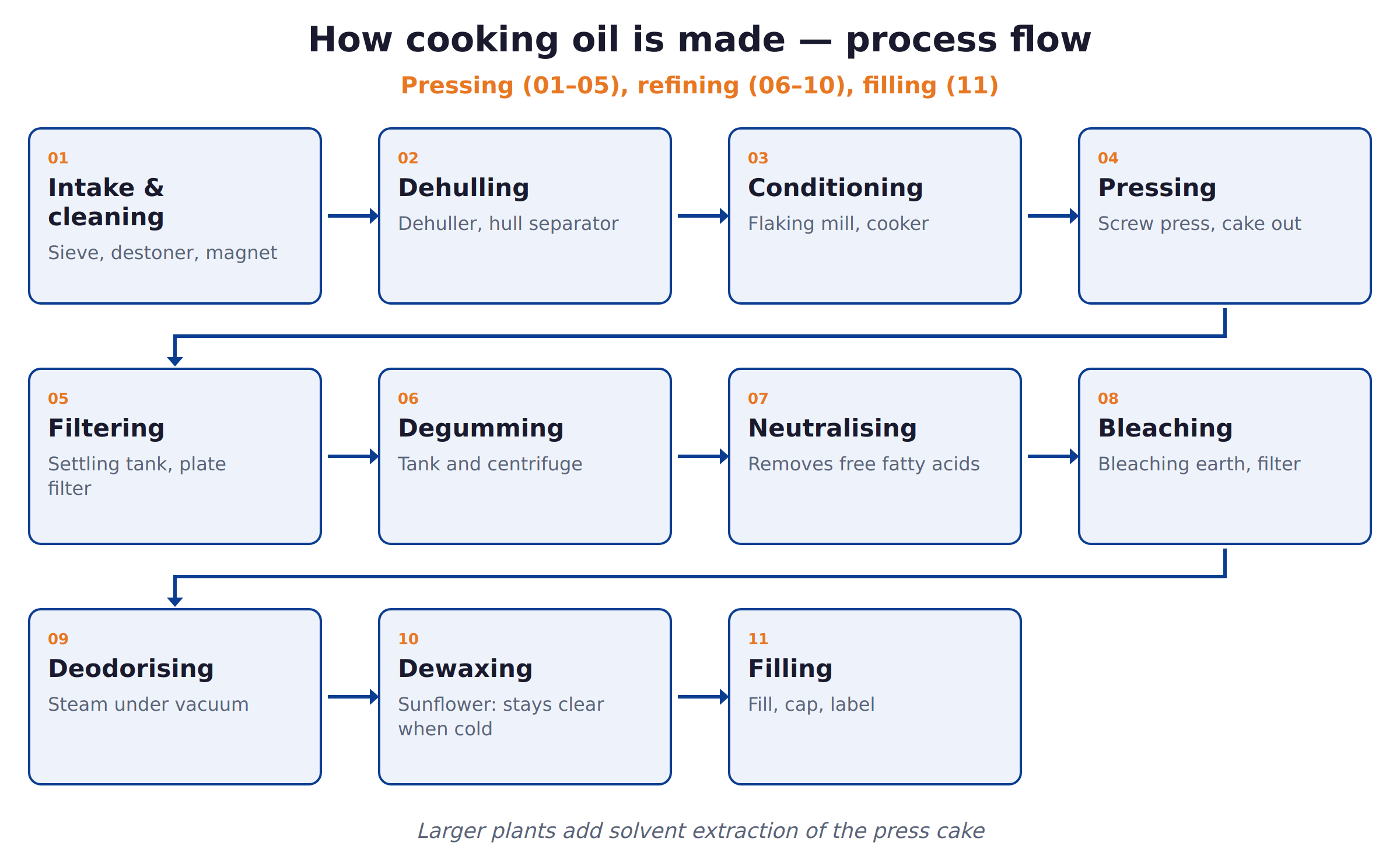
| Pressing line: cleaning, cracking or dehulling, conditioning, pressing, filtering | About 20 t of seed a day | About US$150,000–400,000 ex-works | Crude oil and cake |
| Pressing and refining plant | About 50 t a day | About US$400,000–900,000 ex-works | Refined bottled oil |
| Larger plant | About 100 t a day | About US$700,000–1.5 million+ | Refined oil at scale |
Soybean or sunflower?
| Soybean | Sunflower | |
|---|---|---|
| Oil content | Lower; pressing leaves much oil in the cake | Higher; pressing yields roughly a third of seed weight as oil |
| Main value | Cake for animal feed | Oil |
| Pressing | Often extruded or heated before pressing | Dehulled or pressed whole, then filtered |
| Cake buyers | Poultry, pig and dairy feed makers | Feed makers, at lower protein than soya cake |
| Refining | Degumming important | Winterising to remove waxes for clear oil |
Soybean processors often earn more from cake than oil; sunflower processors earn mostly from oil. Many plants press both, switching by season.
Oilcake and the feed market
Zambia's poultry and livestock sectors use large amounts of soybean cake. Agree sales of cake with feed mills before you start, keep cake dry to prevent mould, and test protein so you can price it fairly.
Power and backup
Expellers, crackers, extruders and refinery pumps are heavy loads. ZESCO said in June 2026 that supply was stable after investment in generation and partnerships with independent producers, and the 2026 Kariba allocation was raised to 36 billion cubic metres. Even so, an interrupted refining batch is costly, so plan backup for critical sections.
Importing an oil plant into Zambia
| Item | 2026 basis |
|---|---|
| Duty | 0% for productive agricultural machinery; most capital equipment in the 0–5% band |
| VAT | 16% on customs value plus duty |
| Valuation | CIF basis |
| Standards | ZABS for regulated goods |
| Corridor | Dar es Salaam, Durban, Walvis Bay or Beira |
| Landed factor | About 1.45–1.60 times ex-works |
Our Zambia import guide explains the corridor decision.
Standards
Bottled oil sold in supermarkets is expected to meet Zambian standards; ZABS is the standards body. Test oil for free fatty acids, peroxide value and moisture, and keep batch records.
Worked example: a soya processor in Central Province
A grain trader in Central Province buys soybeans from farmers and sells them to crushers. He installs a 20 t/day line with cleaning, extrusion and two expellers, and a filter press, and sells filtered soya oil in 20-litre containers to traders and soybean cake to two poultry feed mills. Cake income covers most of the running costs. After two seasons, he plans a small refinery for bottled oil. The figures are illustrative.
How to compare quotes
- Tonnes of seed per day for each seed.
- Pre-treatment: cracking, dehulling, extrusion.
- Residual oil in cake.
- Filtration and refining sections and losses.
- Steam, power and water needs.
- Installation, commissioning on your seed, and training.
- Spares: worms, cages, filter cloths.
- References in southern Africa.
Choose by situation
- Small processor: an expeller with a filter, selling oil and cake locally.
- Seed trader adding value: a 20 t/day pressing line.
- Bottled oil brand: a 50 t/day plant with refining.
- Feed-focused processor: soya extrusion and pressing for cake.
Our sizing guide
The sunflower oil refining line sizing guide sets out what 20, 50 and 100 t/day plants need in space, utilities and staff; the logic applies to soya plants too, with more weight on cake.
What we see in Zambia
- Soybeans and sunflower are the main oilseeds.
- Soybean cake is a key feed ingredient.
- Small expellers serve local markets.
- Refined oil competes with imports in supermarkets.
- Agricultural machinery enters at 0% duty.
- Plants travel far from the sea, so freight is a real part of the budget.
Preparing soybeans for pressing
Soybeans have less oil than sunflower and are harder to press. Many small processors crack the beans and pass them through a dry extruder before pressing: the heat and pressure open the cells so more oil comes out, and the cake is cooked, which makes it better for animal feed. Extruded soybean cake is valued by poultry farmers, which is why soybean processing in Zambia often depends on the feed market as much as on oil sales.
Storing seed through the year
Soybeans and sunflower are harvested once a year, so a plant that runs all year needs seed storage and working capital. Store seed dry, on pallets, with pest control, and check moisture regularly. Buying at harvest is cheaper, but money tied up in seed has a cost; plan finance with that in mind.
Quality for bottled oil
Supermarkets expect clear, stable, odourless oil in sealed bottles. That means refining, good filtration and clean filling, with tests for free fatty acids and peroxide value on every batch.
Space and staff
A pressing line needs seed storage, a pressing hall, oil tanks and a cake store with good ventilation. Plan operators for seed preparation, pressing and filtering on each shift, and a maintenance person who can change press worms and cages. A refinery adds a trained operator, a boiler and a small laboratory.
Packaging
Use food-grade bottles and containers with good seals, store filled stock away from heat and light, and label each container with the product, volume, batch and your details.
Where CISH fits
We supply complete oil plants, seed cleaning, pre-treatment, pressing, filtering, refining and filling, from audited factories in China, sized to your seed and output. CISH ships through the corridor that suits the season, clears, installs and commissions the plant on your seed, and trains your team. For a single expeller, a local supplier is usually the better buy.