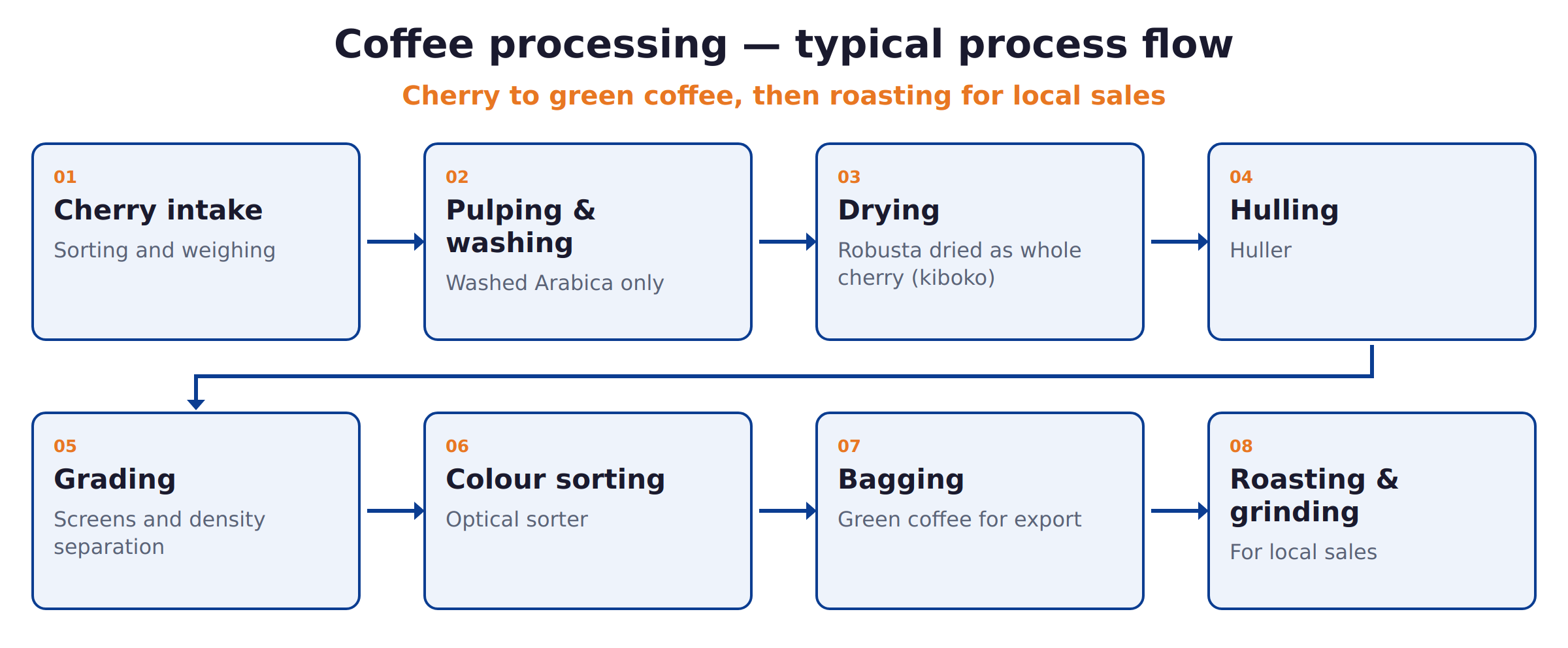
Primary processing turns cherries into green coffee: Robusta is mostly dried as whole cherries (kiboko) and hulled, while washed Arabica is pulped, fermented, washed and dried before hulling. As an indication for 2026, single pulpers and hullers for farms and groups cost about US$200–2,000 each, cleaning and grading machines of about 4–10 tonnes an hour about US$3,000–8,000 each, optical colour sorters about US$10,000–35,000 per unit, and shop roasters of 1–15 kg a batch about US$2,500–8,000, based on factory listings. Industrial roasters and complete export dry mills with hulling, grading, density separation, colour sorting and bagging are priced per configuration. The regulator has changed: the Uganda Coffee Development Authority was dissolved when the amended law took effect on 20 December 2024, and its functions moved to the Ministry of Agriculture, Animal Industry and Fisheries, so confirm current registration and licensing with the ministry. Capital goods usually enter duty-free under the EAC CET, with 18% VAT, and landed costs run at about 1.45–1.60 times ex-works. CISH supplies, installs and commissions complete coffee processing lines.
Coffee processing machine prices in Uganda, 2026
| What you buy | Capacity | Indicative price (2026) | Fits |
|---|---|---|---|
| Huller for dry cherries or parchment | About 80–200 kg an hour | About US$200–2,000 | Farmers, groups, small traders |
| Pulper for fresh cherries | Up to about 800 kg an hour | Within US$200–2,000 | Washing stations, Arabica groups |
| Cleaning and grading machine (screens, gravity table) | About 4–10 t an hour | About US$3,000–8,000 each | Processors and exporters |
| Optical colour sorter | Per unit | About US$10,000–35,000 | Export grading |
| Shop roaster | 1–15 kg a batch | About US$2,500–8,000 | Cafés, local brands |
| Industrial roaster, grinding and packing | Large batches | Quoted per configuration | Local and regional brands |
| Complete export dry mill | Tonnes an hour | Quoted per configuration | Exporters, large co-operatives |
Prices are ex-works listings from Chinese factories, not quotes. For Uganda, budget landed and installed at about 1.45–1.60 times ex-works.
Dry or wet processing?
| Dry (natural, kiboko) | Wet (washed) | |
|---|---|---|
| Common for | Robusta | Arabica, especially on Mount Elgon and Rwenzori slopes |
| Steps | Dry whole cherries, then hull | Pulp, ferment, wash, dry parchment, then hull |
| Machines | Drying yards or dryers, huller | Pulper, fermentation tanks, washing channels, dryers, huller |
| Water | Little | A lot; needs wastewater handling |
| Price | Standard | Often a premium for good washed coffee |
Grading and sorting for export
Exporters buy green coffee by grade: bean size from screens, density from gravity tables, and appearance from colour sorters that remove black, broken and discoloured beans. A dry mill for export typically combines pre-cleaning, destoning, hulling, polishing, screen grading, density grading, colour sorting and bagging. Consistent grades earn better prices.
Roasting for the local market
Café culture and local coffee brands are growing in Kampala and other towns. Shop roasters of 1–15 kg a batch suit cafés and small brands; larger brands need industrial roasters with smoke control, grinders and packing machines with one-way valves.
Regulation after UCDA
The Uganda Coffee Development Authority regulated the sector for decades. Under the amended coffee law, its dissolution took effect on 20 December 2024, and its functions moved to the Ministry of Agriculture, Animal Industry and Fisheries. Processors, roasters and exporters should confirm with the ministry which registrations, licences and quality checks now apply before investing.
Power and drying
Hullers, graders and sorters need electric power; many small hullers also run on diesel engines. UEDCL's approved first-quarter 2026 tariffs were about UGX 203.6 per unit for extra-large and about UGX 300.4 for large industrial users. Drying is mostly on raised beds or patios; mechanical dryers help in wet seasons and for larger volumes.
Importing into Uganda
| Item | 2026 basis |
|---|---|
| Duty | 0% for capital goods under the EAC CET; the 8-digit code decides |
| VAT | 18% |
| UNBS PVoC | Pre-shipment verification for regulated goods |
| Route | Mombasa or Dar es Salaam, then inland |
| Landed factor | About 1.45–1.60 times ex-works |
Worked example: a co-operative adds hulling and grading
A Robusta co-operative in central Uganda sells dried kiboko to traders. It installs a huller, a pre-cleaner and destoner, screen and gravity graders and a colour sorter in a warehouse with three-phase power, and starts selling graded green coffee to exporters. A small roaster is added later for a local brand sold in nearby towns. The co-operative confirms its registration with the Ministry of Agriculture before trading. The figures are illustrative.
How to compare quotes
- Throughput in kilograms of green coffee per hour.
- Hulling losses and bean damage.
- Grading screens for the grades you sell.
- Colour sorter channels and reject rate.
- Roaster batch size, heat source and smoke control.
- Power and engine options.
- Installation, commissioning on your coffee, and training.
- Spares: screens, blades, belts, ejectors.
- References in East Africa.
What we see in Uganda
- Robusta dominates and is mostly dry-processed.
- Washed Arabica comes from highland areas.
- Grading and sorting decide export prices.
- Local roasting is growing.
- The regulator changed in December 2024.
- Coffee machinery is usually duty-free under the EAC CET; VAT is 18%.
Drying makes or breaks quality
Most Ugandan coffee quality is decided before it reaches a machine. Cherries that are picked ripe, dried quickly on raised beds or tarpaulins off the ground, and stored dry make clean coffee; cherries dried on bare earth, rewetted by rain or stored damp develop mould and off-flavours that no huller or sorter can remove. Processors who buy kiboko should check moisture on delivery and pay more for well-dried coffee, and co-operatives that train members on drying usually earn better prices from exporters.
Moisture, storage and traceability
Green coffee should be stored at safe moisture in clean bags on pallets, away from walls, chemicals and fuel. Exporters and their buyers increasingly ask where coffee was grown and how it was processed, so keep records of farmers, lots, drying and milling. Good records support better prices and help meet the traceability rules of international buyers, including requirements in some export markets that coffee be traced back to the farms where it was grown.
Washing stations for Arabica
Washed Arabica is processed at washing stations near farms: cherries are sorted, pulped the same day, fermented in tanks, washed in channels and dried as parchment on raised beds. Washing stations need clean water, a way to treat or settle wastewater so it does not pollute streams, and good management of fermentation times. A well-run washing station can lift the price farmers receive for their cherries.
Staff and training
Hullers, graders and sorters need trained operators who set machines for each lot and check samples for defects. Train staff in cupping basics so they can recognise quality problems early.
Where CISH fits
We supply coffee processing lines, hulling, cleaning, grading, colour sorting, roasting and packing, from audited factories in China, sized to your coffee and output. CISH ships through Mombasa or Dar es Salaam, clears, installs and commissions the line on your coffee, and trains your team. For a single small huller or pulper, a local supplier is usually the better buy.