Families building on stands in stages, contractors and developers all buy them, and cement bricks have grown because they need no kiln and no firewood. Imported machines come overland from Durban through Beitbridge, so landed costs run at about 1.45–1.60 times ex-works; regulated goods need a CBCA certificate before loading, or face a penalty of 12% of CIF value; and import VAT rose to 15.5% in January 2026. Power has been steadier in 2026, with no scheduled load-shedding through the winter, but many yards still use diesel engines. CISH supplies, installs and commissions semi-automatic and automatic brick and block plants in Zimbabwe.
Brick moulding machine prices in Zimbabwe, 2026
| What you buy | Typical output | Indicative price (2026) | Fits |
|---|---|---|---|
| Manual brick moulding machine | Hundreds of bricks a day | Low end of the US$8,000–40,000 band, or local machines | Self-builders, small yards |
| Electric or diesel egg-laying machine | Thousands of bricks or blocks a day | US$8,000–40,000; yard under about US$80,000 | Brick yards |
| Hydraulic press | Dense bricks at moderate output | Within the US$8,000–40,000 band | Yards selling face bricks |
| Semi-automatic static plant | Bricks, blocks, pavers at volume | About US$120,000–450,000 landed and commissioned | Contractors, developers |
| Fully automatic plant | Large volumes | From about US$600,000 (civils extra) | Large suppliers |
Common bricks or cement bricks?
| Common (fired clay) bricks | Cement bricks and blocks | |
|---|---|---|
| Material | Clay, fired in a kiln | Cement, sand, quarry dust |
| Process | Mould, dry, fire | Mix, press or vibrate, cure |
| Fuel | Firewood or coal for the kiln | None for curing; power or diesel for the machine |
| Investment | Kiln and land | Machine, mixer, slab |
| Consistency | Varies with firing | Even, if mixed and cured well |
Cement bricks avoid kiln fuel and give even sizes; common bricks remain popular and cheap where clay and fuel are at hand.
Cement, sand and curing
Cement is the main cost per brick. Use clean, well-graded sand or quarry dust, weigh or measure the mix the same way every time, and cure bricks damp and shaded for days before stacking. Bricks cured too quickly in the dry season are weak and break in transport.
Power
The Herald reported that by late October 2026 Zimbabwe had gone 304 days without scheduled load-shedding, and that 2026 was the first winter in more than two decades without a day of it. Electric machines are a sound option where your connection is reliable; diesel machines and generators remain common for yards on the edges of towns.
Importing a plant into Zimbabwe
| Item | 2026 basis |
|---|---|
| Payments at import | Duty, surtax where applicable, and VAT, per the Tariff Handbook |
| VAT | 15.5% from 1 January 2026 |
| CBCA | Certificate needed before loading for regulated goods; 12% of CIF penalty without it |
| Route | Durban, then road through Beitbridge |
| Landed factor | About 1.45–1.60 times ex-works |
Plan the CBCA inspection with the factory test so the certificate exists before the machine is crated. Our Zimbabwe import guide explains the sequence.
Worked example: a brick yard in Chitungwiza
A builder in Chitungwiza buys common bricks for his clients and waits weeks during busy periods. He sets up a yard with an electric egg-laying brick machine and a mixer, uses quarry dust and river sand, waters bricks twice a day under shade cloth, and buys a used truck. Families building on new stands become regular customers. When a developer asks for blocks and pavers, he plans a semi-automatic static plant, with the CBCA certificate arranged before shipment. The figures are illustrative.
How to compare quotes
- Bricks per shift for your brick size.
- Pressing or vibration system.
- Moulds included and extra mould costs.
- Mixer type.
- Power or engine and connected load.
- Installation, commissioning on your materials, and training.
- Spares: moulds, vibrators, hydraulic seals.
- References in southern Africa.
Choose by situation
- Self-builder or small yard: a manual or small electric machine.
- Brick yard: an egg-laying machine with a mixer.
- Contractor or developer: a semi-automatic static plant.
- Large supplier: an automatic plant.
Our guides
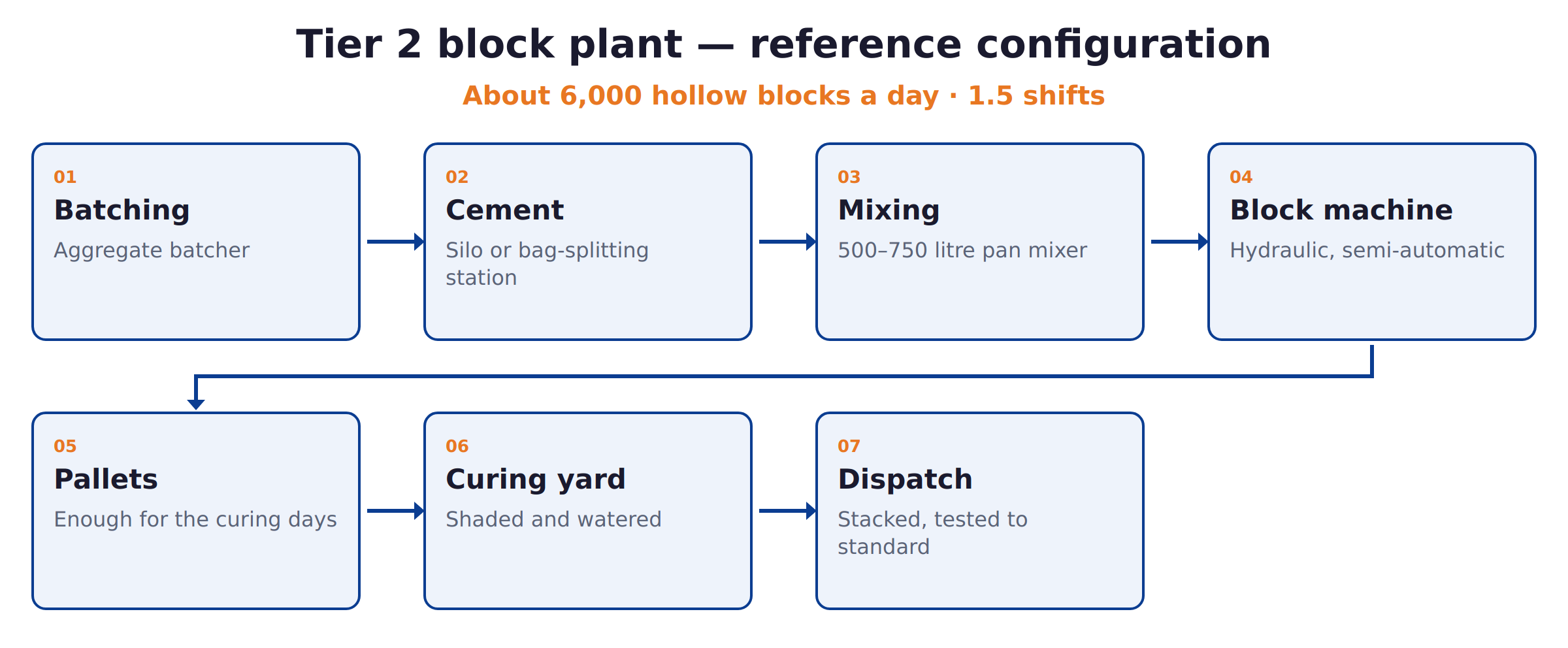
The block plant sizing guide sets out the output, space and staff for each tier, and applies to cement bricks as well as blocks.
What we see in Zimbabwe
- Common bricks and cement bricks both sell widely.
- Building in stages keeps demand steady.
- Cement is the main cost.
- Power was steadier in 2026, but diesel backup is common.
- CBCA certificates come before shipment for regulated goods.
- VAT is 15.5% from January 2026.
Quarry dust and sand
Many Zimbabwean brick yards use quarry dust from stone crushers, sometimes mixed with river sand. Quarry dust can make strong, sharp-edged bricks, but its quality varies: too much fine dust weakens bricks and needs more cement, while well-graded dust compacts well. Test materials from your supplier, keep stockpiles clean, and adjust the mix when the source changes.
Selling to people building in stages
Many families build a house over several years, buying bricks in loads as money allows. They value a yard that keeps prices steady, delivers when promised, and keeps the same quality from one load to the next so walls match. Keep records of regular customers and their building stage, and offer delivery in loads that suit them. Contractors and developers want larger loads on a schedule and invoices.
Maintenance
Moulds wear with every cycle; worn moulds make bricks of uneven size and with rough edges. Check moulds regularly, keep spares, and maintain vibrators, hydraulic seals and engines.
Water and curing yard
Cement bricks need water for mixing and curing every day. Plan a borehole, a tank or a reliable supply, and a curing yard with shade cloth or covers. In the hot months before the rains, bricks need watering several times a day; in heavy rain, cover fresh bricks so they are not damaged.
Licences and site
Register the business, get the local authority's permission for the site, and choose an area zoned for light industry, because brick yards make noise and dust.
Delivery
A truck with a crane or tipper saves handling and breakages; plan delivery charges by distance and load.
From a delivered project: A regional developer asked for a 12,000 blocks-a-day automatic plant; sized to real off-take, the plant built was about 6,500 blocks a day over two shifts, online in 22 weeks and at 78% effective utilisation within three months. Read the block and paver plant case study.
Where CISH fits
We supply semi-automatic and automatic brick and block plants, mixers, batching, machines, moulds, pallet handling and curing, from audited factories in China, sized to your bricks a day. CISH arranges the CBCA inspection with our factory test, ships through Durban and Beitbridge, clears, installs and commissions the plant on your materials, and trains your operators. For a manual machine, a local supplier is usually the better buy.