The machine matters less than cement, which is the largest cost per block, good sand, enough water for curing, and a truck for delivery. Because Zambia is landlocked, imported plants arrive through Dar es Salaam, Durban, Walvis Bay or Beira, and landed costs run at about 1.45–1.60 times ex-works. Capital equipment mostly falls in the 0–5% duty band, with 16% import VAT on customs value plus duty. Power improved in 2026, with ZESCO saying in June that it did not expect nationwide load management to return this year, but many yards still run diesel engines. CISH supplies, installs and commissions semi-automatic and automatic block and paver plants in Zambia.
Block making machine prices in Zambia, 2026
| What you buy | Typical output | Indicative price (2026) | Fits |
|---|---|---|---|
| Manual mould or hand press | A few hundred blocks a day | Low end of the US$8,000–40,000 band, or local machines | Site production, small yards |
| Egg-laying (mobile) vibrated machine | Thousands of blocks a day | US$8,000–40,000; yard under about US$80,000 | Block yards |
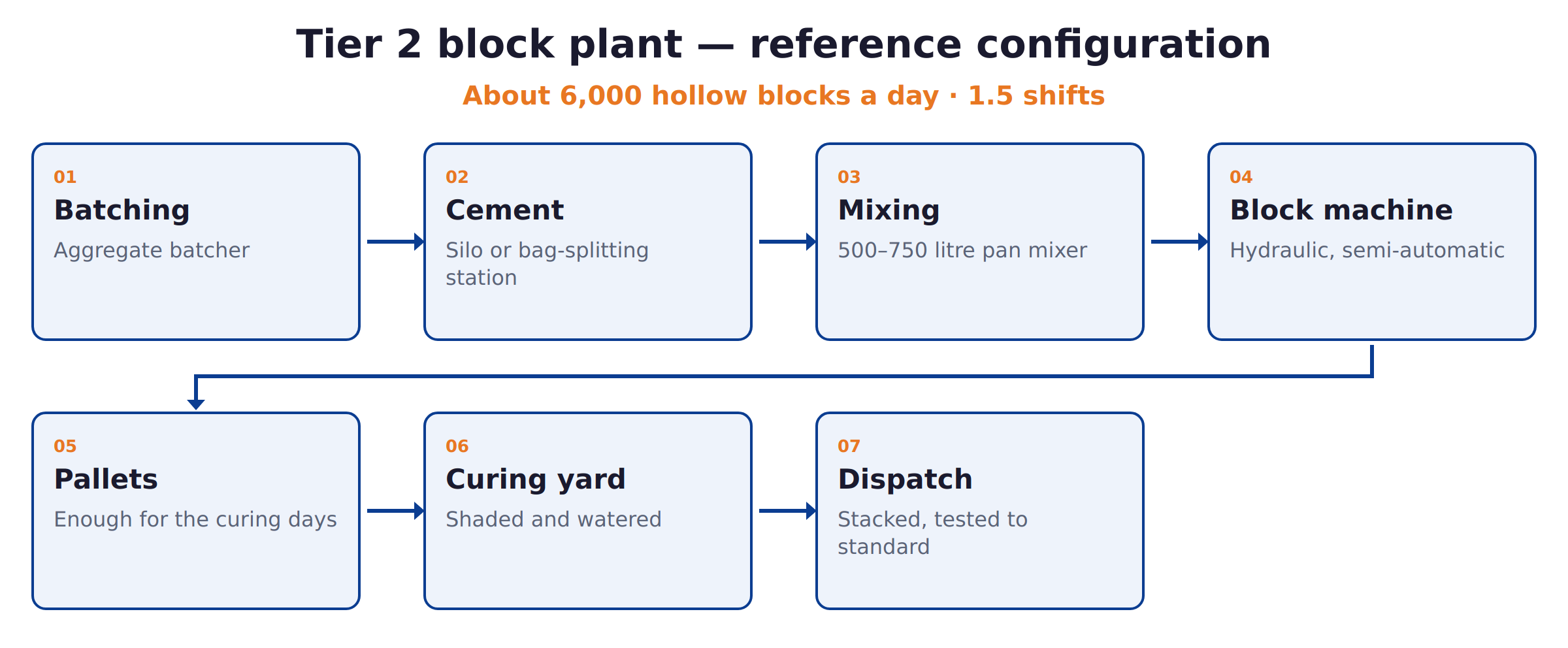
| Semi-automatic static plant | Consistent blocks, pavers and kerbs | About US$120,000–450,000 landed and commissioned | Contractors, developers, supply contracts |
| Fully automatic plant | Large volumes | From about US$600,000 (civils extra) | Large suppliers |
Mobile or static?
| Egg-laying (mobile) | Static plant | |
|---|---|---|
| How it works | Moves along a slab, laying blocks on the floor | Blocks made on pallets and taken to curing |
| Slab | Large, level concrete slab | Smaller footprint plus curing area |
| Products | Hollow and solid blocks | Blocks, pavers, kerbs |
| Consistency | Depends on operator and mix | Higher; controlled vibration and compaction |
| Power | Diesel or small electric motor | Three-phase supply |
Cement, sand and curing
Cement is the largest cost per block, and its price moves with supply and transport costs, so buy carefully and store bags dry. Sand must be clean and well graded; dirty sand weakens blocks. Water fresh blocks several times a day and keep them shaded for days before stacking, especially in the hot, dry months before the rains, when blocks dry too quickly. A yard that cures well can sell stronger blocks at a better price.
Power and fuel
ZESCO said in June 2026 that supply was stable and that nationwide load management was not expected to return this year, helped by a larger Kariba water allocation for 2026 of 36 billion cubic metres shared between ZESCO and Zimbabwe's power company. Egg-laying machines and mixers often run on diesel; static plants need three-phase power. Keep a generator or engine as backup.
Importing a plant into Zambia
| Item | 2026 basis |
|---|---|
| Duty | Mostly in the 0–5% band for capital equipment; the tariff line decides |
| VAT | 16% on customs value plus duty |
| Valuation | CIF basis |
| Standards | ZABS for regulated goods |
| Corridor | Dar es Salaam, Durban, Walvis Bay or Beira |
| Landed factor | About 1.45–1.60 times ex-works |
Our Zambia import guide explains the corridor choice, and our block plant sizing guide sets out output, space and staff for each tier.
Delivery and customers
Builders, contractors, developers and families building homes buy blocks. Most want delivery, so a tipper or flatbed truck is part of the business. Supply contracts with contractors and developers give steady volume; walk-in sales pay better per block.
Worked example: a block yard on the Copperbelt
A contractor in Kitwe buys blocks for his projects and often waits for supply. He sets up a yard with an egg-laying vibrated machine, a mixer, a borehole and shade covers, and a used tipper. He sells to two developers and to walk-in customers, and keeps a diesel engine for the machine. When a mining town housing project asks for pavers, he plans a semi-automatic static plant with paver moulds. The figures are illustrative.
How to compare quotes
- Blocks per shift for your block sizes.
- Vibration and compaction system.
- Moulds included and extra mould costs.
- Mixer type and capacity.
- Pallets and curing plan for static plants.
- Power or engine and connected load.
- Installation, commissioning on your materials, and training.
- Spares: moulds, vibration motors, bearings.
- References in southern Africa.
Choose by situation
- Small yard: an egg-laying machine with a mixer.
- Contractor with steady projects: a semi-automatic static plant.
- Pavers and kerbs: a static plant with paver moulds and a face mix.
- Large supplier: an automatic plant.
What we see in Zambia
- Concrete blocks are the main walling material.
- Egg-laying machines run most small yards.
- Cement is the largest cost.
- Power improved in 2026, but diesel backup remains common.
- Capital equipment mostly pays 0–5% duty, with 16% VAT.
- The trip from the port to a Zambian yard adds freight, clearing and time.
Curing in Zambia's dry season
From the end of the rains until the first storms, Zambia is dry and hot, and fresh blocks lose water fast. Yards that water blocks only once a day, or leave them in full sun, sell weak blocks that crack on site. Shade cloth, plastic sheets over fresh rows, and watering several times a day for the first days make a large difference. In the rainy season the risk changes: fresh blocks need cover from heavy rain, and sales slow as building pauses, so build stock before the rains and keep cash for the quieter months.
Working with contractors
Contractors and developers want steady quality, delivery on time and invoices. Give them a sample batch for testing, agree the block size and strength they need, and keep enough stock for their next phase. A yard that becomes a regular supplier to a few contractors has steadier income than one that depends only on walk-in customers.
Moulds and spare parts
Moulds wear with every cycle, and worn moulds make blocks of the wrong size with rough edges. Check moulds regularly, keep a spare set for your main block size, and service vibration motors, bearings and engines on a schedule. Spare parts for imported machines should be ordered with the machine, because shipping them later through the corridor takes time.
Licences
Register the business, get the council's licence for the site, and check zoning: block yards are noisy and dusty, so industrial or mixed-use sites suit them best.
From a delivered project: A regional developer asked for a 12,000 blocks-a-day automatic plant; sized to real off-take, the plant built was about 6,500 blocks a day over two shifts, online in 22 weeks and at 78% effective utilisation within three months. Read the block and paver plant case study.
Where CISH fits
We supply semi-automatic and automatic block and paver plants, mixers, batching, block machines, moulds, pallet handling and curing, from audited factories in China, sized to your blocks a day. CISH ships through the corridor that suits the season, clears, installs and commissions the plant on your materials, and trains your operators. For a manual or egg-laying machine, a local supplier is usually the better buy.