As an indication for 2026, manual and hydraulic ISSB presses, manual block machines and egg-laying machines fall in a band of about US$8,000–40,000, with a whole small yard under about US$80,000; semi-automatic static plants that make blocks and pavers cost about US$120,000–450,000 landed and commissioned; fully automatic plants from about US$600,000. Because equipment travels inland from Mombasa or Dar es Salaam, landed costs run at about 1.45–1.60 times ex-works for imported plants. Capital goods usually enter duty-free under the EAC CET, with 18% VAT. CISH supplies, installs and commissions semi-automatic and automatic block and paver plants in Uganda.
Block, paver and ISSB machine prices in Uganda, 2026
| What you buy | Product | Indicative price (2026) | Fits |
|---|---|---|---|
| Manual ISSB press | Interlocking soil-cement blocks | Within the US$8,000–40,000 band, at the low end; also made locally | Self-builders, community and school projects |
| Hydraulic ISSB machine | Interlocking blocks at higher output and density | Within the US$8,000–40,000 band | ISSB producers, contractors |
| Egg-laying (mobile) block machine | Hollow and solid concrete blocks | US$8,000–40,000; yard under about US$80,000 | Block yards |
| Semi-automatic static plant | Blocks, pavers, kerbs | About US$120,000–450,000 landed and commissioned | Contractors, municipal and estate work |
| Fully automatic plant | High volumes of blocks and pavers | From about US$600,000 (civils extra) | Large suppliers |
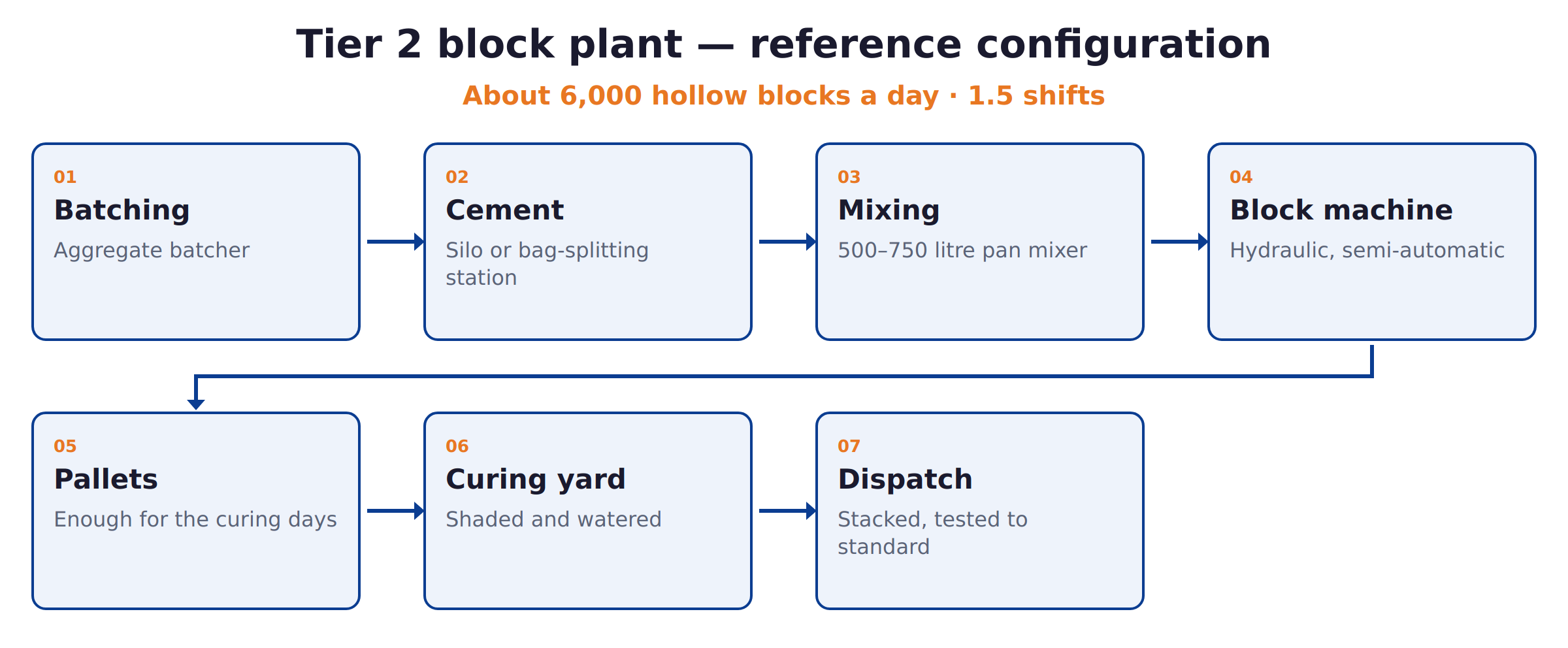
ISSB, concrete blocks or pavers?
| ISSB | Concrete blocks | Pavers | |
|---|---|---|---|
| Material | Soil (often murram or laterite) with a small share of cement | Cement, sand, aggregate | Cement, sand, aggregate, pigment |
| Mortar | Little or none; blocks interlock | Normal mortar | Laid on sand, no mortar |
| Strength and finish | Good for low-rise walls when well made | Good for most walls | Designed for traffic |
| Investment | Low | Low to moderate | Moderate to high |
| Key skill | Soil testing, correct cement share, pressing and curing | Mix design, compaction, curing | Face mix, compaction, curing, colour control |
ISSB saves cement, mortar and transport when good soil is near the site, but builders must be trained in the system. Concrete blocks suit most urban building. Pavers need a static plant and good quality control.
Soil, cement and curing
ISSB quality depends on the soil: it must have the right mix of sand and clay, tested before production, and the cement share must be enough for strength. Concrete blocks and pavers depend on cement content, aggregate grading and compaction. In every case, cure blocks damp and shaded for days, because blocks that dry too quickly are weak.
Power
Manual ISSB presses need no power; hydraulic ISSB machines and egg-laying machines often run on diesel engines or small motors; static plants need a three-phase supply. UEDCL took over distribution in 2025, and approved first-quarter 2026 tariffs were about UGX 203.6 per unit for extra-large and about UGX 300.4 for large industrial users. Plan a generator where supply is uncertain.
Importing a plant into Uganda
| Item | 2026 basis |
|---|---|
| Duty | 0% for capital goods under the EAC CET; the 8-digit HS code decides |
| VAT | 18% |
| UNBS PVoC | Pre-shipment verification for regulated goods |
| Route | Mombasa or Dar es Salaam, then road or rail inland |
| Landed factor | About 1.45–1.60 times ex-works |
Local workshops
Kampala's metalworking workshops, including the Katwe cluster, make manual presses, moulds, frames and repair machines. They are a good choice for simple ISSB presses and spare moulds. Our guide to fabrication companies in Uganda explains where local and imported machines fit.
Worked example: an ISSB producer adds pavers
A contractor near Mukono produces ISSB for school and housing projects on two hydraulic presses, using murram from a nearby pit. A municipal contractor and several estate developers ask for pavers for compounds and access roads. The contractor installs a semi-automatic static plant with paver moulds, a pan mixer and a face-mix hopper on a concrete slab, with a generator, and keeps the ISSB presses running. Pavers are cured under shade for a week before stacking. The figures are illustrative.
How to compare quotes
- Units per shift for each product, not a generic block.
- Pressing or vibration system and compaction force.
- Moulds included: block sizes, ISSB profiles, paver shapes.
- Mixer type: pan mixer for pavers.
- Face-mix system for coloured pavers.
- Pallets and handling.
- Power or engine and connected load.
- Installation, commissioning on your materials, and training.
- Spare moulds and wear parts.
- References in East Africa.
Choose by situation
- Self-builder or community project: a manual ISSB press.
- ISSB producer: hydraulic ISSB machines and soil testing.
- Block yard: an egg-laying machine with a mixer.
- Contractor wanting pavers: a semi-automatic static plant.
- Large supplier: an automatic plant.
What we see in Uganda
- ISSB is widely used for affordable and school buildings.
- Concrete blocks dominate urban building.
- Pavers are growing for compounds, estates and municipal roads.
- Local workshops make simple presses and moulds.
- The road from the coast adds to every imported plant.
- Block machines usually pay no duty, though VAT of 18% applies on arrival.
Testing ISSB soil
Good ISSB starts with the soil. Before buying a press, take samples from the pit you plan to use and test them: a simple jar test shows the share of sand, silt and clay, and test blocks pressed with different cement shares show which mix gives enough strength after curing. Soils with too much clay crack as they dry; soils with too much sand crumble. Many producers screen the soil to remove stones and roots, mix soil and cement dry, add a measured amount of water and press immediately, because the mix stiffens quickly once water is added.
Building with interlocking blocks
ISSB walls go up faster than mortared walls because blocks lock together, but they need trained masons, accurate first courses, and ring beams and reinforcement where the design calls for them. Producers who train builders or work with contractors who know the system sell more blocks and get fewer complaints. For public buildings and schools, check what the client's engineer specifies for strength and testing.
Pavers for compounds and roads
Homeowners, hotels, schools and municipalities increasingly pave compounds, parking areas and access roads. Pavers need a stiff mix, strong compaction and careful curing, and coloured pavers need a face mix with pigment. Keep colour batches separate so a whole compound matches, and lay a sample area for clients before they order.
Where CISH fits
We supply semi-automatic and automatic block and paver plants, mixers, batching, block machines with block and paver moulds, face-mix systems, pallet handling and curing, from audited factories in China, sized to your units a day. CISH ships through Mombasa or Dar es Salaam, clears, installs and commissions the plant on your materials, and trains your operators. For manual ISSB presses, a local workshop is usually the better buy.