As an indication for 2026, manual and mobile block machines cost about US$8,000–40,000, and a whole small project around them usually stays under about US$80,000; a semi-automatic hydraulic block plant costs about US$120,000–450,000 landed and commissioned; and a fully automatic plant with batching, conveyors, curing and stacking costs about US$600,000–1.5 million and more, with civil works on top. Equipment landed at a coastal port such as Dar es Salaam typically costs about 1.25–1.45 times its ex-works price. Cement is the largest running cost, and prices vary by region, so output, mix design and curing decide profit more than the machine price. Interlocking stabilised soil block machines are a separate, low-cement option popular for low-cost housing. Capital goods generally pay 0% duty under the EAC Common External Tariff, and VAT may be deferred for qualifying capital goods. CISH supplies, installs and commissions block plants from semi-automatic to fully automatic.
Block machine prices, 2026
| Tier | What it is | Indicative price (2026) |
|---|---|---|
| Manual and mobile machines | Egg-laying or small stationary machines; a few workers | About US$8,000–40,000 (whole project usually under US$80,000) |
| Semi-automatic hydraulic plant | Stationary press with mixer and pallets | About US$120,000–450,000 landed and commissioned |
| Fully automatic plant | Batching, conveyors, curing and stacking | About US$600,000–1.5 million and more, civils extra |
| Landed at a coastal port | All tiers bought ex-works | About 1.25–1.45 times the equipment price |
Our block plant sizing guide explains each tier and its output.
What you can make
- Hollow and solid blocks in common widths for walls and foundations.
- Paving blocks for driveways, roads and yards, with colour.
- Kerbstones for roads.
- Interlocking stabilised soil blocks from soil and a little cement, pressed on separate machines.
Most yards start with hollow blocks and add paving when they have a colour mixer and buyers.
Output per day
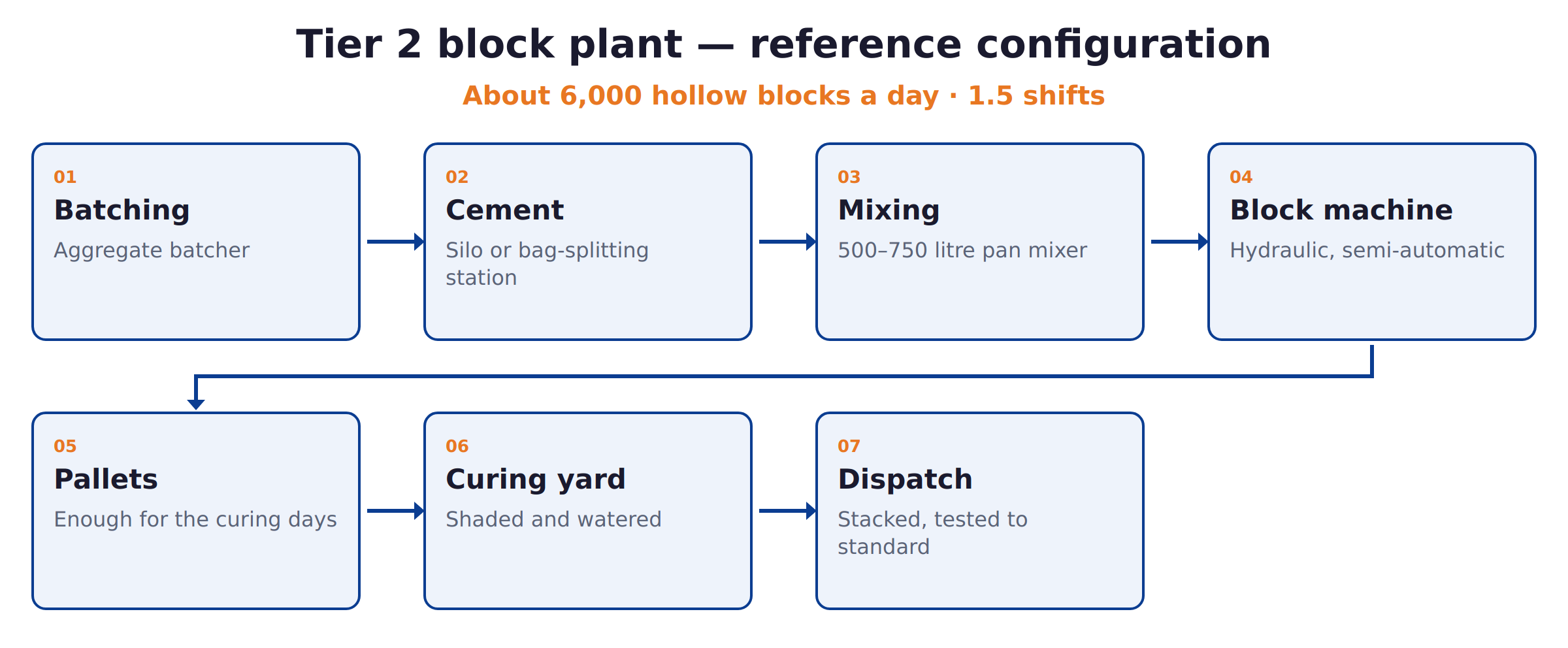
A manual machine relies on workers to mix, fill and carry blocks, so output varies with the team. Semi-automatic hydraulic plants make many times more, with consistent compaction. Fully automatic plants run continuous cycles with conveyors and curing. In every tier, real output depends on mixing, pallets, curing space and the team, not only the press cycle. Count the curing yard: every block made today needs space for days.
What drives the price
- Output per hour and cycle time.
- Vibration and compaction: stronger vibration and hydraulic pressure give denser blocks.
- Moulds: each block size or paving shape needs a mould.
- Mixer and batching: manual mixing, pan mixer or automatic batching.
- Pallets: wood, steel, plastic or composite, and how many.
- Handling: manual, stacker or cuber.
- Curing: open yard, covered yard or curing chambers.
Landed cost in Tanzania
A block press is usually classified as machinery for shaping mineral materials, and capital goods of that kind generally enter at 0% under the EAC tariff. Moulds, steel pallets and spare parts are often classified separately and may carry other rates, so list them as separate lines on the invoice. Import VAT of 18% applies on the value plus duty unless the plant qualifies for deferment, which TRA administers. Cement mixers and electrical panels may fall under TBS's PVoC list; check before the line ships. Then add the costs that make a press into a plant: foundations, a level curing yard with drainage, a power connection, water, installation and operator training. Our guide to importing a production line into Tanzania covers the route.
Cement, sand and quality
Cement is the largest running cost, followed by sand and aggregates. Prices vary by region and season. A good mix design, accurate batching and proper curing let you make strong blocks with less cement. Test blocks for strength at a laboratory, especially if you sell to contractors and public projects, and keep the results to show buyers.
Power, water and site
Semi-automatic and automatic plants need three-phase power, with backup if supply is unreliable. You need water for mixing and curing, a level yard with drainage, cover for cement storage, and access for sand trucks and delivery vehicles. Sites near growing towns and main roads reduce delivery costs, which matter because blocks are heavy.
Interlocking soil blocks
Interlocking stabilised soil block machines press soil with a small share of cement into blocks that lock together, reducing mortar. They suit low-cost housing and rural projects, and are promoted for their lower cement use. They are a different product and market from concrete blocks; choose by your buyers.
How to compare quotes
Ask each supplier for output per eight-hour shift for your block size, the compaction method, mould prices and spares, pallet type and number, mixer and batching, power requirements, curing recommendations, installation, training and support. Compare the landed project cost, not the machine price.
From a delivered project: A regional developer asked for a 12,000 blocks-a-day automatic plant; sized to real off-take, the plant built was about 6,500 blocks a day over two shifts, online in 22 weeks and at 78% effective utilisation within three months. Read the block and paver plant case study.
Common mistakes
- Buying a press without enough pallets or curing space.
- Under-mixed or under-cured blocks that fail strength tests.
- No mould plan for the sizes buyers want.
- No backup power for a hydraulic plant.
- Sites far from buyers, making delivery costly.
Selling blocks in Tanzania's growing towns
Demand for blocks follows building: houses on the edges of growing towns, apartments and commercial buildings in Dar es Salaam, Dodoma, Arusha and Mwanza, and public works such as schools, health centres and roads. Small builders and homeowners usually buy by the hundred from yards near their sites and want delivery; contractors buy in larger volumes, often with strength requirements and credit terms. Paving blocks sell to developers, petrol stations, hotels and municipalities. A yard close to building activity, with its own truck and reliable delivery, wins orders even against cheaper blocks from further away.
Pallets and moulds: count them before you order
A press is only as productive as the pallets under it. Each pallet carries fresh blocks to the curing yard and stays there until they can be moved, often for a day or more, so a plant needs enough pallets for its curing time plus spares. Steel pallets last longest; wooden pallets are cheaper but wear. Each block size and paving shape needs its own mould, and moulds wear with use, so buy a second set for your best-selling block.
Labour and training
Even semi-automatic plants need a team for mixing, handling pallets, curing, stacking and loading. Train operators on mix proportions, vibration time and curing, because these, not the machine, decide whether blocks pass strength tests.
Strength testing
Contractors and public buyers often ask for compressive strength results. Send sample blocks to an accredited laboratory regularly and keep the reports with your batch records. Test after the curing period your buyers specify, and test every new mix before you sell it.
Where CISH fits
We supply semi-automatic and fully automatic block plants, presses, mixers, batching, pallets, conveyors and curing, from audited factories in China, sized to your blocks and buyers. CISH ships the plant, installs and commissions it on your materials, and trains your team. For a single manual machine, a local dealer or fabricator is usually the better buy.