CISH supplies, installs and commissions semi-automatic and automatic block and paver plants; for a single manual press, a local fabricator is the better buy.
Block and cabro machine prices in 2026
| What you buy | Typical output | Indicative price (2026) | Fits |
|---|---|---|---|
| Manual interlocking soil block press | A few hundred blocks a day with a small crew | A few thousand US dollars or less, bought locally | Self-builders, youth groups, rural housing |
| Manual or mobile concrete block machine | Hundreds to a few thousand blocks a day | About US$8,000–40,000 per machine | Small yards and site production |
| Small complete project | One machine, mixer, pallets, curing area | Usually under US$80,000 | First block business |
| Semi-automatic block and paver plant | Thousands of blocks or several hundred m² of cabro a day | About US$120,000–450,000 landed and commissioned | Hardware suppliers and contractors |
| Fully automatic plant | Continuous production with batching and stacking | About US$600,000–1.5 million or more, civil works extra | Regional suppliers and large estate projects |
Manual presses are bought in Kenyan shillings from local workshops; we give them only as a US-dollar order of magnitude. Imported plants are priced in US dollars.
Which block are you selling?
| Product | Who buys it | Machine route |
|---|---|---|
| Interlocking stabilised soil blocks (ISSB) | Rural homes, schools, self-builders | Manual or hydraulic press; soil and a little cement |
| Hollow and solid concrete blocks | Contractors and hardware shops, as an alternative to makiga | Vibrating block machine with moulds for each size |
| Cabro paving blocks | Estates, driveways, parking, petrol stations | The same plant with paver moulds and often a colour face layer |
| Kerbs and drainage units | Road and estate contractors | Heavier moulds and stronger vibration |
In Kenya, makiga, machine-cut quarry stone, is still the walling most builders know. A concrete block business has to compete with it on price per square metre of wall, accuracy and delivery, not on price per block.
Manual, semi-automatic or automatic?
| Manual press | Semi-automatic plant | Fully automatic plant | |
|---|---|---|---|
| Crew | Several people per press | A small team per shift | A few operators and a supervisor |
| Quality | Depends on the operator and the mix | Consistent density with vibration and pressing | Most consistent, with weighed batching |
| Cabro | Limited | Yes, with paver moulds | Yes, including two-layer colour pavers |
| Power | None or small | Three-phase supply for vibration, mixer and hydraulics | Larger supply, batching and conveyors |
| Main risk | Weak blocks and slow output | Mould wear and curing space | Sales volume to keep the plant busy |
Move up when buyers want consistent blocks in volume, not only because the manual press is busy.
Who sells block machines in Kenya
- Jua kali workshops and local fabricators build manual presses, moulds, pallets and simple egg-laying machines, and repair them quickly.
- Dealers sell imported egg-laying and stationary machines from stock.
- Chinese factories selling direct offer stationary block machines, mixers, batching and complete plants by catalogue.
- Turnkey companies design the plant, supply it, and commission it on your aggregates.
We name no block machine sellers here, by policy. Ask every seller for output per eight-hour shift for each block and paver size, on aggregates like yours, and for the mould price and expected life.
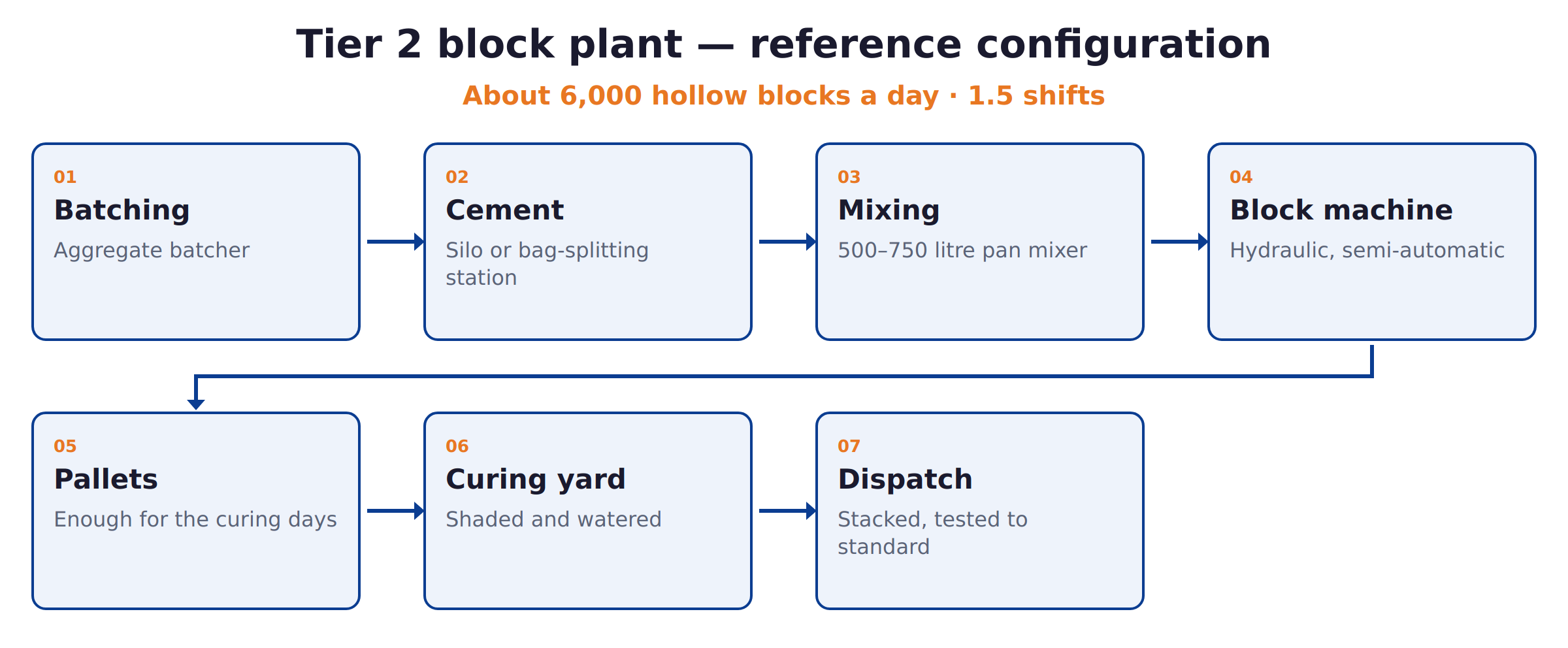
What a complete block and paver plant includes
- Aggregate storage and feeding: bays or bins for sand, ballast and quarry dust.
- Batching and mixing: weighed cement, aggregate and water for consistent strength.
- Block machine: vibration and pressing, with moulds for each product.
- Face-mix unit for cabro: if you sell coloured pavers.
- Pallets and transfer: steel or composite pallets in the right number.
- Stacking and curing: curing area or chambers; blocks gain strength over days.
- Cubing and wrapping: for delivery to site.
- Testing: a press for cube or block strength, to answer customers and tenders.
- Power and water: three-phase connection, starters, water for mixing and curing.
Power and running costs in Kenya
Most block plants are not heavy power users compared with mills, but vibration motors, mixers and hydraulics still run all day. Kenya Power bills carry pass-through charges above the base tariff; in August 2026 the fuel energy cost charge alone was about KES 3.5 per kilowatt-hour. Efficient motors, correct starters and good power factor reduce the bill per thousand blocks. Ask each seller for installed power and the expected kWh per shift.
Importing a block plant into Kenya
| Item | How to plan for it |
|---|---|
| Import duty | Capital equipment is usually duty-free under the EAC Common External Tariff; check the HS code of each machine and mould |
| VAT | Charged at 16% on the import |
| Import Declaration Fee | 2.5% of the customs value |
| Railway Development Levy | 2% of the customs value |
| KEBS PVoC | Where the product is regulated, conformity is verified in China before loading |
| Route | Mombasa port, then the Standard Gauge Railway or road inland |
Moulds and pallets are bulky; ask the seller how many containers the plant needs, because freight and inland transport can be a large share of the landed cost.
Worked example: a semi-automatic plant for a hardware supplier
An illustration only, not a quote:
| Item | Assumption |
|---|---|
| Products | 6-inch and 9-inch hollow blocks, plus 60 mm and 80 mm cabro |
| Output | Several thousand blocks a shift, or a few hundred m² of cabro |
| Plant price | Within US$120,000–450,000 landed and commissioned, depending on batching and stacking |
| Land | Yard for aggregates, the plant shed and a curing area that holds several days of output |
| Crew | A small team per shift |
| Key cost per block | Cement, then aggregates and transport |
The curing yard is usually the constraint people forget. If blocks cannot cure for long enough before delivery, customers see broken corners and weak pavers.
How to compare quotes
- Output per shift for each block and paver size.
- Cycle time and how it is measured.
- Mould material, hardness and price per spare mould.
- Number of pallets supplied.
- Batching by weight or by volume.
- Face-mix unit for coloured cabro included or not.
- Installed power and the supply you need.
- Curing method and the area it requires.
- Installation, commissioning on your aggregates, and training.
- Warranty, and who answers for output after handover.
From a delivered project: A regional developer asked for a 12,000 blocks-a-day automatic plant; sized to real off-take, the plant built was about 6,500 blocks a day over two shifts, online in 22 weeks and at 78% effective utilisation within three months. Read the block and paver plant case study.
Mistakes we see
- Buying a machine for one block size. Contractors ask for several sizes and pavers; check moulds.
- Too few pallets. The machine waits while blocks cure.
- Mixing by bucket. Strength varies and complaints follow.
- No curing space. Blocks are sold too early and crack.
- Ignoring quarry dust quality. Fines and clay content change strength and appearance.
- Comparing price per machine instead of price per finished block.
What we see in Kenya
- Interlocking blocks are promoted locally. Nakuru County says it has kept training youth and organised groups to make interlocking blocks as an alternative walling material.
- Estates use cabro. Affordable Housing Programme estates such as the Wote project in Makueni list cabro-paved driveways among their features, which creates demand for pavers alongside walling.
- A national housing programme. The Affordable Housing Programme, run through the Boma Yangu portal, is building estates across the counties, and contractors source blocks and pavers near each site.
- Makiga competition. Quarry stone remains the walling material many builders default to, so concrete blocks must win on accuracy and wall cost.
- Duty is usually zero, levies are not. Block machines generally enter duty-free under the EAC tariff, but VAT, the Import Declaration Fee and the Railway Development Levy still apply.
- PVoC sequencing. KEBS verification happens before loading in China, so plan it into the factory schedule.
- Electricity surcharges. Pass-through charges make efficient motors worth paying for.
- Strong local fabrication. Jua kali workshops make moulds, pallets and repairs, which helps keep imported plants running.
Where CISH fits
CISH supplies, installs and commissions semi-automatic and automatic block and cabro plants from audited factories in China: batching, mixing, block machine, face-mix, pallets, stacking and curing, with the import into Kenya arranged and the plant commissioned on your aggregates. For a manual press or a single small machine, a local fabricator or dealer is the better choice, and we will say so.