The fuel for the oven is the big choice. Many Zambian bakeries learned during the 2024 drought, when Kariba's usable storage fell to about 13% and load-shedding stretched for hours, to bake with diesel ovens or keep a generator. Power has improved: ZESCO said in June 2026 that it did not expect nationwide load management to return this year, so electric ovens are again an option where the supply is strong. Imported equipment arrives through Dar es Salaam, Durban, Walvis Bay or Beira, with landed costs at about 1.45–1.60 times ex-works; most capital equipment falls in the 0–5% duty band, with 16% import VAT. Flour is the largest running cost.
Bakery equipment prices in Zambia, 2026
| What you buy | Indicative price (2026) | Fits |
|---|---|---|
| Machine set: spiral mixer, divider, moulder, prover, deck or rack oven | About US$15,000–45,000 | Small and medium bakeries |
| Semi-automatic bread line | From about US$80,000 | Bakeries supplying shops and supermarkets |
| Fully automatic line with tunnel oven | About US$250,000–800,000+ | Bread factories |
Landed and installed in Zambia, add the corridor and inland transport: about 1.45–1.60 times ex-works for imported equipment.
Oven choice: diesel, electric or gas
| Oven fuel | Strength | Watch for |
|---|---|---|
| Diesel | Bakes through power cuts | Fuel cost and fumes |
| Electric | Clean, precise, no fuel deliveries | Large load; needs a strong, reliable supply |
| Gas (LPG) | Even baking, clean | Gas supply logistics and safe installation |
| Wood | Cheap fuel | Smoke, uneven bakes, cleanliness |
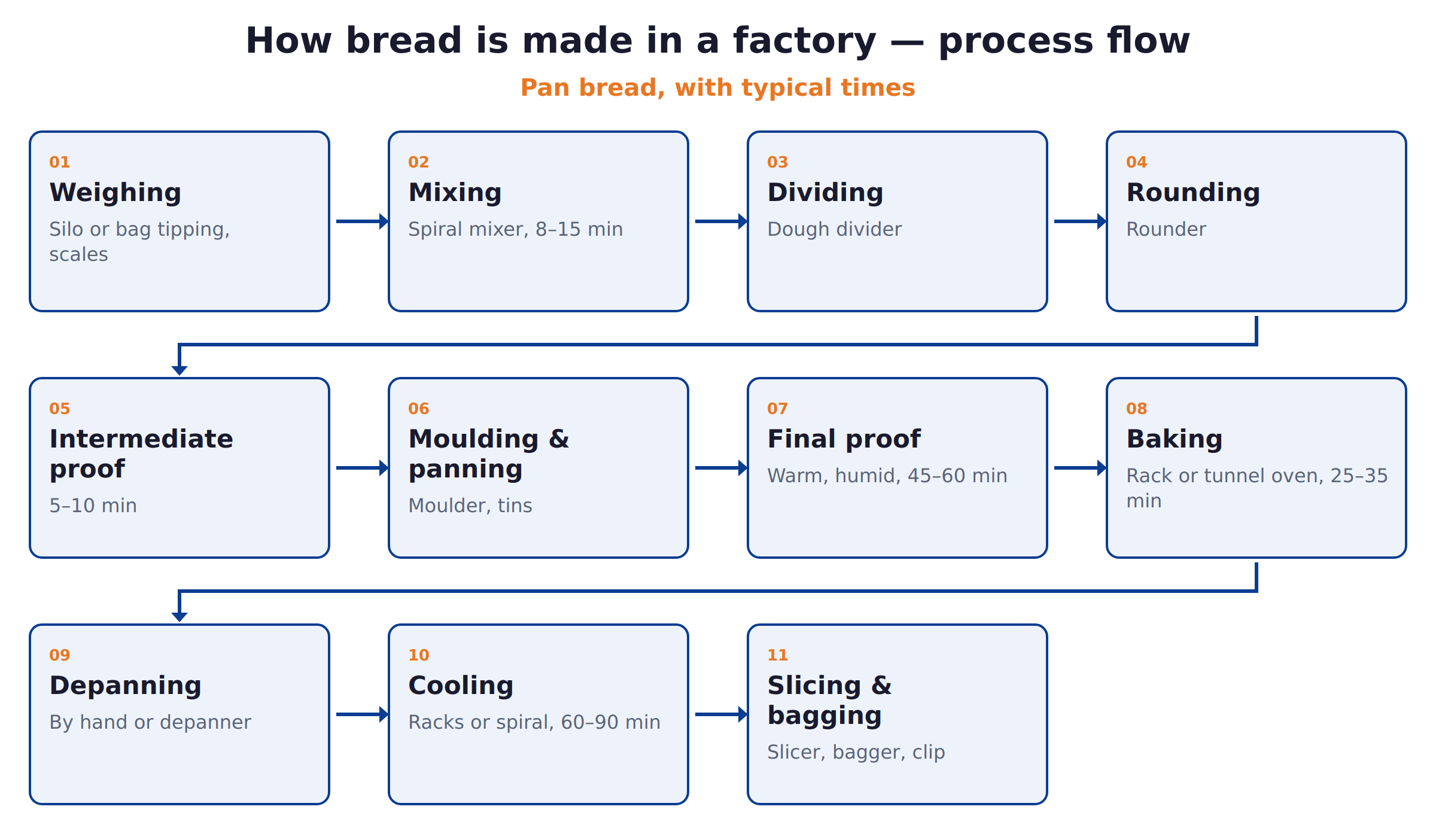
A common choice is a diesel or gas rotary rack oven with electric mixers, dividers and provers, plus a generator sized to keep the provers and mixers running.
The machines that matter as much as the oven
- Spiral mixer: consistent dough, batch after batch.
- Dough divider and rounder: equal loaf weights save flour.
- Moulder: even loaves that bake evenly.
- Prover with humidity control: even rising, fewer misshapen loaves.
- Slicer and bagger: for sliced bread in shops.
- Cooling racks or spiral cooler: bread must cool before slicing.
Importing bakery equipment into Zambia
| Item | 2026 basis |
|---|---|
| Duty | Mostly in the 0–5% band for capital equipment; the tariff line decides |
| VAT | 16% on customs value plus duty |
| Valuation | CIF basis |
| Standards | ZABS for regulated goods |
| Corridor | Dar es Salaam, Durban, Walvis Bay or Beira |
| Landed factor | About 1.45–1.60 times ex-works |
Flour and running costs
Flour is the largest running cost, followed by fuel or power, sugar, fat, yeast and labour. Weigh dough pieces, plan bakes to match orders, and track fuel per batch. A bakery that wastes a few grams on every loaf or bakes more than it sells loses its margin quickly.
Worked example: a Kitwe bakery moves to a rack oven
A bakery in Kitwe bakes bread in two deck ovens and supplies kantemba shops and two supermarkets. Output is limited, and during load-shedding in 2024 production stopped. The bakery installs a diesel rotary rack oven, a larger spiral mixer, a divider-rounder, a moulder and a prover with a generator, and keeps one deck oven for scones and cakes. Output nearly doubles and production no longer stops when the grid fails. The figures are illustrative.
How to compare quotes
- Loaves per hour for your loaf size.
- Oven type, fuel and consumption per batch.
- Mixer bowl size and dough capacity.
- Divider accuracy and range.
- Prover control of temperature and humidity.
- Slicing and bagging speed.
- Generator size for backup.
- Installation, commissioning and training.
- Spares: burners, belts, blades, seals.
- References in southern Africa.
Choose by situation
- Small bakery: a deck oven with a mixer and prover.
- Growing bakery: a diesel or gas rack oven with a divider and moulder.
- Supermarket supplier: a semi-automatic line with slicing and bagging.
- Bread factory: an automatic line with a tunnel oven.
Our guides
The bakery equipment guide compares bakery classes across our markets, and power and line selection helps choose between grid, generator and solar.
What we see in Zambia
- Bread, buns and scones are everyday products.
- Diesel ovens and generators spread during the 2024 load-shedding.
- Power improved in 2026.
- Supermarket supply needs sliced, wrapped bread.
- Most capital equipment pays 0–5% duty, with 16% VAT.
- Ovens and mixers arrive by road from coastal ports, which adds to the landed cost.
Bread, buns and scones for kantemba shops
Much of Zambia's bread is sold through small kantemba shops and kiosks in compounds and townships, which buy daily and pay cash, alongside supermarkets that buy on terms. A bakery that serves both needs early deliveries, a range of loaf sizes, and buns and scones that sell well with tea. Plan products for each channel: unwrapped or simply bagged loaves for kantemba shops, sliced and branded loaves for supermarkets.
Staff and training
Bakers who understand dough handle flour, yeast and temperature better and waste less. Train staff on mixing times, dough temperature, proving and baking, and on safe use of dividers, mixers and ovens. Many bakery problems blamed on machines are solved by better training and routines.
Maintenance and spares
Keep spare belts, blades, seals and oven parts on site, and service mixers, dividers and ovens on a schedule. Ovens that run on diesel need burner servicing; electric ovens need checks on elements and contactors. A bakery that cannot bake for a day loses customers to the bakery down the road.
Work areas in the bakery
A bakery needs separate areas for flour storage, mixing and dough handling, proving, baking, cooling and packing, so that flour dust stays away from finished bread and work flows in one direction. Ventilation is essential around ovens, and floors should be easy to clean. Plan electrical points, gas or fuel lines and drains before machines arrive.
Delivery
Bread must reach shops before opening. Plan routes, vehicles and crates, and agree order quantities so that returns of unsold bread stay low.
Costing products
Work out the cost of each product, including flour, other ingredients, fuel or power, labour and packaging, and review it monthly. Some products carry the margin; others mainly bring customers in.
Flour supply
Buy flour from more than one miller, check each delivery for quality, and keep a few weeks of stock in a dry store off the floor.
Where CISH fits
We supply complete bakery lines, mixing, dividing, moulding, proving, baking, cooling, slicing and bagging, from audited factories in China, sized to your loaves a day and your fuel. CISH ships through the corridor that suits the season, clears, installs and commissions the line, and trains your bakers. For a single oven or mixer, a local dealer is usually the better buy.